Marketers under pressure to support corporate revenue growth and demonstrate returns on all their ad spend know how important accuracy is in attributing app installs and other customer interactions to the marketing campaign that drove those contacts. Without it, you’re left guessing — or, worse, heading in the wrong direction — when making key decisions around optimizing your marketing investments.
Apple’s App Tracking Transparency (ATT) framework makes gathering accurate attribution data a much heavier lift.
What is App Tracking Transparency, and why does it matter for measurement?
ATT requires an iOS app to obtain permission from iPhone users before correlating user or device data it collects with information other companies gather through apps, websites, etc. This tracking is crucial for measuring a campaign’s success, but marketers’ insight into user behavior is inherently limited when it hinges on the user proactively granting permission for data tracking.
ATT in practice
Users grant ATT-compliant permission through the ATT prompt, a pop-up with Apple-required language. The prompt must display, “Allow [app name] to track your activity across other companies’ apps and websites?” Apps may include brief custom text designed to encourage the user to allow tracking, but the prompt can offer only two choices: “Allow Tracking” or “Ask App Not to Track.” Opting out is the default.
![Screenshot of the ATT prompt: "[Your app] would like permission to track you across apps and websites owned by other companies. Your data will be used to deliver personalized ads to you." Two buttons read "Allow tracking" and "Ask app not to track."](https://www.branch.io/wp-content/uploads/2026/08/ATT_Blog_Inline-1-946x724-1-1440x1102.webp)
Apps are not required to include an ATT prompt. Those that don’t get explicit user permission will not be able to use the Identifier for Advertisers (IDFA) to track the user or Apple device. So that app’s provider will not be able to tie data it collects about the user’s activity within the app to other companies’ experiences with the same user (or device).
Requiring users to opt in has put a damper on data tracking. Only around 35% of app users consent when offered an ATT prompt. Gaming and e-commerce apps have the highest opt-in rates, at 39% and 36%, respectively, while publications have a rate of 19% and educational apps only 14%.
For users who agree to be tracked, marketers can access granular data needed to personalize the user experience and gauge the effectiveness of ad campaigns. For app users who don’t opt in, you have to rely on aggregated data and alternative strategies to understand user behavior and preferences. Maximizing the proportion who opt-in is crucial.
How to implement ATT and optimize opt-ins
You can use several techniques to increase ATT opt-in rates:
- Boost the value of the customized text included in the ATT pop-up by tailoring it to the target audience and specifying the benefits to the users of opting in. Keep the prompt to one sentence. It should state the value of opting in directly. A message like “We will use your data to better tailor your experience with [app name] to your specific interests” works. The goal is to make consent as easy as possible.
- Add pre-prompt communication that primes users for the opt-in ask. Communicate why users are being asked to allow the app to track their data and why they should say yes. Keep the messaging brief and straightforward.
- Maximize opt-ins by adjusting the timing of the ATT prompt. Apple does not dictate when the pop-up should appear. Onboarding is always a delicate process, and requesting permission to track new users’ data might discourage them from moving forward with the app. Consider including the prompt after the user has experienced value, such as after their first in-app purchase, rather than when the app is downloaded. A/B test multiple iterations of the tailored prompt, as well as any pre-prompt messaging, to verify their effectiveness. Experiment with different timings of the ask. The more data you collect on opt-in optimization, the stronger your future campaigns will be.
No single timing choice or prompt verbiage is right for every organization. The most effective approach for your marketing team depends on users’ trust in your company and your app. Those who feel the app is safe are more likely to opt into tracking.
What to do about opt-outs
No matter how well you plan your ATT strategy, some users are going to opt out. Getting as much information as possible about these users’ activities, while staying ATT compliant, requires you to close the data gaps between their behavior with your app and their interaction with your campaigns. You need dedicated tools that can differentiate between users who opt in and those who don’t, while still providing a holistic view of your user base.
To improve marketers’ understanding of iOS app users who opt out of data tracking, Apple’s SKAdNetwork (SKAN) provides insights about campaign performance by replacing user-level tracking with data aggregation that protects individuals’ privacy. It’s an important source for a high-level view. It lacks the granularity and speed you need to make data-driven marketing decisions in real time.
Branch’s proprietary Predictive Aggregate Measurement (PAM) layers predictive modeling on top of SKAN, AdAttributionKit, and other aggregated-data sources for users who do not consent to tracking. By pairing this data with behavior of users who opt in, PAM helps app developers understand which marketing efforts drive installs, opens, and in-app activity.
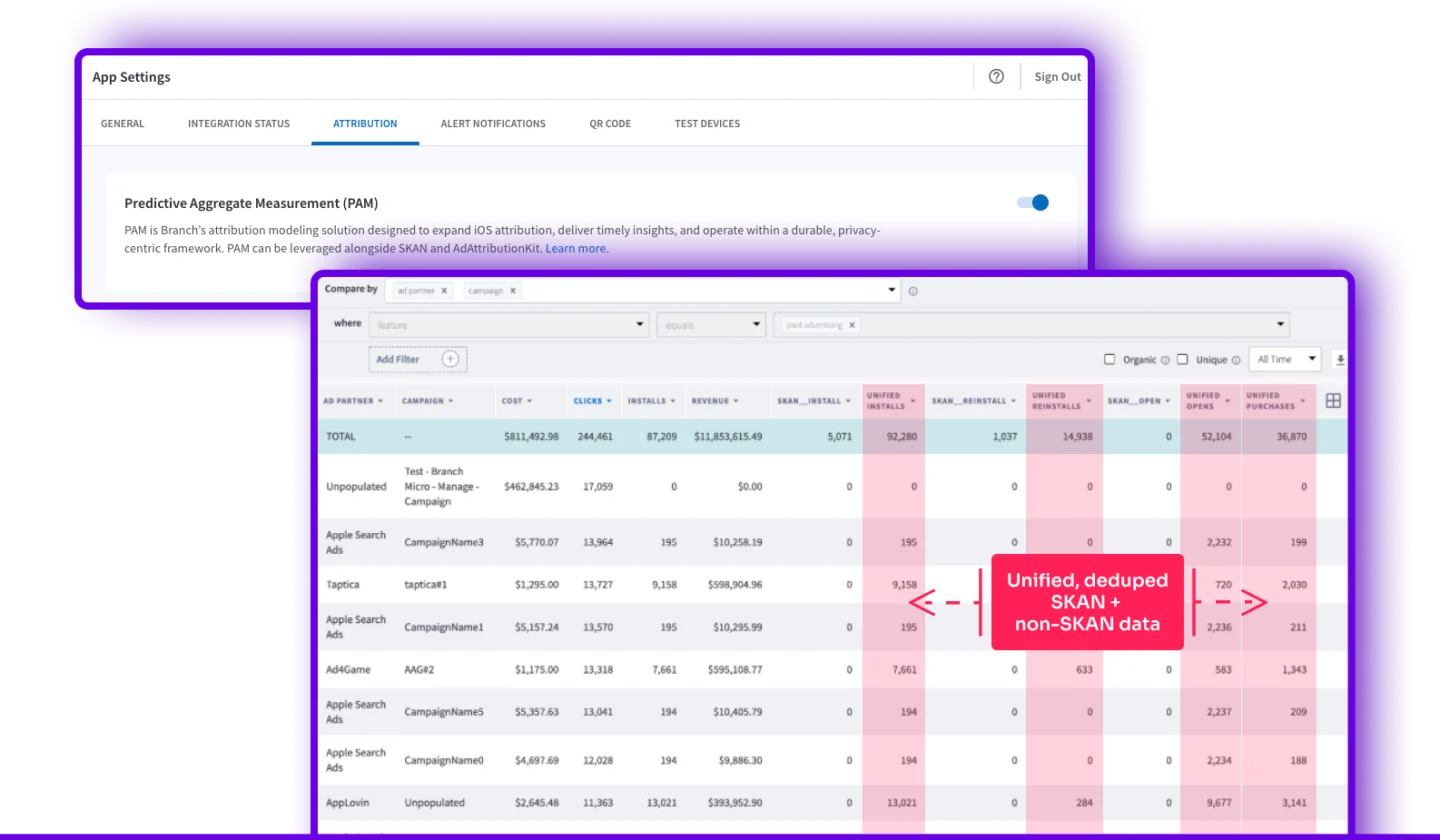
Branch PAM combines deterministic attribution methods such as IDFA tracking for consenting users and campaign-level (anonymized) SKAN data, with probabilistic modeling to extrapolate whether a marketing touchpoint, such as an ad, email, website link, QR code, or SMS message, led to a user action.
During implementation, you can set attribution windows for different behaviors. For example, you might attribute an install to an ad campaign if it happens within seven days of a click. Configure your application windows based on your industry, business model, and typical purchase cycle.
The goal is to capture all real conversions without overattributing user actions to campaigns that didn’t significantly influence them.
Branch PAM expands visibility into campaign performance. By capturing conversions that SKAN tools previously missed or misclassified as organic, Branch PAM enables marketing teams to attribute an average of 118% more app installs than SKAN alone. That number is significantly higher in certain industries: 154% growth for travel brands, 344% growth for shopping brands, 527% growth for entertainment brands, and 656% growth for finance brands.
Common mistakes in ATT optimization
Despite ATT requirements, optimizing marketing campaign performance doesn’t have to be a guessing game. Marketers can turn to new technologies to ensure they’re basing decisions on the best possible information about user engagement and conversion patterns.
The most direct source of campaign performance information comes from opt-in users, so marketing teams redesigning performance measurement processes should be careful to avoid:
- Poor prompt placement. Including the ATT prompt at the wrong place in the user journey reduces the likelihood users will consent to tracking.
- Weak prompt UX. Likewise, those whose ATT prompt messaging fails to convince users to opt in will have less direct user-behavior data to analyze.
- Skipping pre-permission priming. Messaging before the ATT prompt is optional, but it helps build users’ trust in the app and understanding of the benefits of selecting “allow.”
- Insufficient testing. Across all three areas, failing to test the effectiveness of different prompt options will result in suboptimal performance, reducing the amount of user information you have.
After optimizing your ATT prompt, look to your mobile measurement partner (MMP) to fill the gaps it leaves behind. Branch PAM operates within evolving privacy requirements, protecting user data while delivering, in real time, accurate and detailed attribution insights. This visibility to user engagement and conversion patterns equips marketing teams with the data you need to justify past expenditures and plan future campaigns.
Privacy safeguards do not have to come at the expense of timely and accurate information. The right tools can show you which user segments are most engaged, where you should be investing marketing dollars, and how to optimize for growth. Now it’s up to you to implement them.
See how Branch helps marketers understand the two-thirds of iOS users who opt out of data tracking.
FAQs about Apple’s ATT
Apple’s iOS App Tracking Transparency (ATT) is a framework that requires iOS apps to obtain permission from an iPhone user before correlating data they collect on that user or device with information other companies gather through apps, websites, or offline properties. Opting out is the default.
ATT obtains permission through a pop-up window, also known as the ATT prompt. The pop-up must first display the question “Allow [app name] to track your activity across other companies’ apps and websites?” It must give users the option to click either “ask app not to track” or “allow.” In between these elements, the ATT prompt can include customized text explaining why the app wants to track user data.
No, implementing the ATT is not mandatory. Apps that don’t get explicit user permission will not be able to use the Identifier for Advertisers (IDFA) to track the user or Apple device.
Across all types of apps, only around 35% of users click “allow” when offered an ATT prompt. For gaming and e-commerce apps, opt-in rates are 39% and 36%, respectively, while publications have a rate of 19% and educational apps only 14%.
Apple’s SKAN framework provides aggregated insights about campaign performance. Branch’s Predictive Aggregate Measurement (PAM) layers predictive modeling on top of SKAN for app users who have not consented to tracking. By pairing this data with behavior patterns of users who’ve opted in, Branch PAM helps marketers understand which marketing efforts contribute to app installs, app opens, and down-stream conversions.