In a fiercely competitive app market, launching your app is just the beginning. The real challenge is cutting through the noise to drive downloads and attract users who will become loyal, engaged customers. Knowing how to promote an app effectively means going beyond a single channel and building a coordinated strategy that drives installs, engagement, and long-term retention.
A successful promotion strategy focuses on sustainable growth, acquiring users at a reasonable cost, using your app regularly, and ultimately generating revenue. It’s about balancing acquisition costs with long-term user value.
Here are the most effective ways to promote an app across channels and build a data-driven strategy that maximizes your return on investment (ROI).
How to promote your app with app store optimization
App store optimization (ASO) is the foundation of your app store presence and the endpoint every other channel depends on. You can run a well-funded paid campaign, but if users land on a weak app store page, they won’t convert.
Core ASO tactics include:
- An eye-catching app icon and a clear, memorable title
- Compelling short and long app descriptions
- Informative, well-designed screenshots and a promo video
- Prompting users to review your app and responding to negative feedback directly
- Careful keyword selection focused on relevance, not volume alone
Beyond the basics, advanced ASO strategies can meaningfully improve visibility. Seasonal keyword optimization, such as adjusting your keyword set around holidays, events, or industry cycles, helps you capture high-intent searches at the right moment.
Competitor analysis lets you identify gaps in their listings and position your app more effectively. A/B testing your screenshots, icons, and descriptions through tools likeGoogle Play’s store listing experiments orApple’s product page optimization gives you data to back every creative decision.
ASO is not a one-time setup. Treat it as an ongoing program by monitoring keyword rankings, tracking conversion rates on your store page, and iterating based on the data.
For more details, check out these ASO best practices for driving app discovery.
How to promote your app through your website
If you already have a website with an SEO strategy in place, you have a cost-efficient channel ready to drive app installs. The key is building a frictionless path from web to app. Here’s how:
- Use smart app banners for mobile visitors. Deep-linked banners capture web visitors and route them directly into your app. If users don’t have your app yet, a deferred deep link will route them through the install process, then to the intended app content. Smart banners go a step further by targeting users by page URL, location, or referral source and tailoring the call to action (CTA) to match user intent. A visitor on a product page sees an invitation to view that item in the app; a lapsed user on your homepage sees a reengagement prompt.
- Offer a text-me-the-app option or desktop banner for desktop visitors. Text-me-the-app lets users send a deep link to their phone, routing them to the appropriate app store and directly to relevant in-app content after install. Desktop banners take a different approach — displaying a customized interstitial with a QR code that visitors can scan to go straight to your app, no link click required.
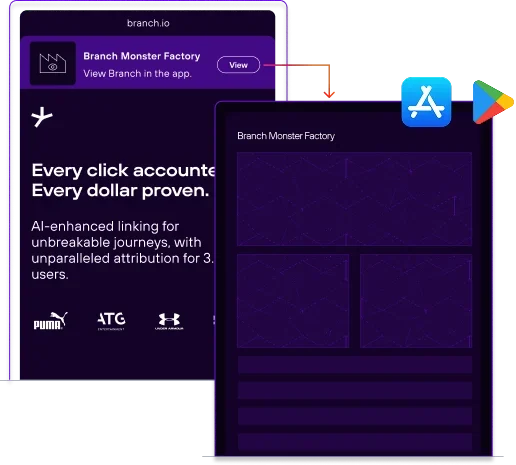
Combining smart banners and desktop-to-mobile flows creates a web presence that actively converts visitors into app users.
How to promote your app on social media
Social media gives you access to large, targetable audiences across both paid and organic channels. The challenge is that most platforms are walled gardens — their designs keep users on-platform, which means native analytics only tell part of the story. Connecting social engagement to actual app installs and conversions requires measurement that exists outside the platform itself.
That measurement challenge aside, platform selection still matters, and different platforms reach very different audiences. TikTok’s App Promotion objective lets you optimize campaigns across installs, in-app events, and value-based outcomes, making it well suited for consumer apps targeting younger demographics. On the other hand, Instagram Stories ads occupy the full screen with interactive elements like link stickers and polls, giving app marketers a high-visibility format to drive downloads.
Using deep links in both organic and paid social posts routes users directly to relevant in-app content, even through install. Without them, a user who taps your Instagram ad and doesn’t have your app installed lands on a generic app store page — and if they do install, they open to your home screen with no connection to what they originally tapped. Deep links preserve that context through the install process, so the experience a user expects from your ad is the experience they actually get. This improves conversion at every step and gives you a consistent link structure across all platforms that makes cross-channel attribution possible.
For paid social, platform dashboards will almost always make your campaigns look better than they are. Each platform optimizes for its own metrics, which means you’re rarely seeing an accurate picture of what’s actually driving installs and revenue. Solutions like Branch’s Universal Ads cut through that by providing cross-platform attribution that tracks the full journey from social ad exposure through install and in-app conversion.
How to promote your app through referrals and user reengagement
Your existing users are one of your most valuable channels. Referral programs and reengagement campaigns both rely on the same principle: Users who already know your app can drive growth more efficiently than cold acquisition. Here are two ways to make them work for you:
1. Build a referral program that leverages trust. When a friend recommends an app, the referred user arrives with higher intent and converts at a better rate than users from paid channels. An effective program includes:
- In-app sharing capabilities to make referrals frictionless
- Incentives like discount codes or in-app rewards to motivate users
- Deep-linked attribution to apply rewards automatically and deliver personalized experiences without promo codes
2. Run reengagement campaigns to prevent churn. A significant share of users will open an app once and not return without a prompt. Bring them back with targeted campaigns:
- Push notifications, in-app messaging, and paid retargeting can bring lapsed users back before they churn permanently.
- Deep links within these campaigns route users directly to relevant content, increasing the chances of reactivation.
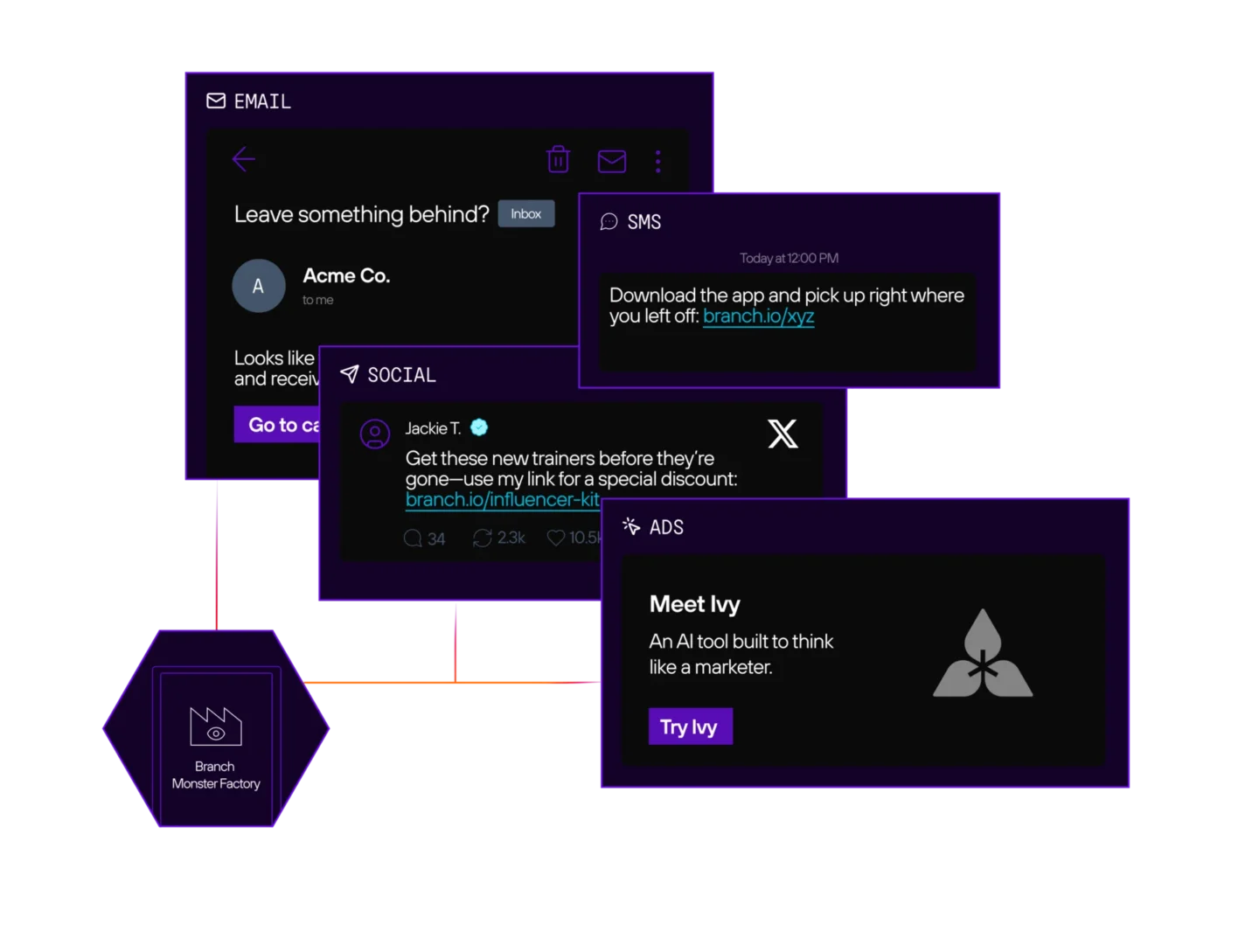
Together, referral and reengagement programs extend the value of every acquired user. Rather than treating them as separate initiatives, build them as complementary parts of a lifecycle strategy that keeps users engaged and turns satisfied users into a growth channel.
How to promote your app with email marketing
Email remains one of the highest-ROI channels for app promotion, particularly for driving reengagement among existing users. The shift by users to mobile email consumption makes campaigns built for the app experience, not just the inbox, essential.
Effective email promotion goes beyond mobile-optimized templates. Segmentation lets you tailor messaging based on user behavior, like:
- Win-back campaigns to lapsed users
- Onboarding sequences to new installs
- Feature announcements to power users
Lifecycle automation ensures these messages reach users at the right moment without requiring manual campaign management.
The attribution gap is a persistent challenge in email, and it starts at the link level. On iOS, the standard deep linking method conflicts with how email service providers (ESPs) handle click tracking: Maintaining your ESP’s click reporting means sacrificing a seamless app experience, and enabling deep linking typically means turning off click tracking. Most teams end up choosing between data and user experience. Branch’s Universal Email solves this by working directly with ESPs so click tracking stays intact while Branch handles the deep linking. Links automatically route users based on install status: They prompt users without the app to download before they land on their intended content, and users who already have it go straight there.
When you can measure email’s true impact on app engagement and revenue, you can optimize campaigns with confidence and allocate budget to the segments and messages that actually move the needle.
How to promote your app with paid advertising
Paid mobile advertising offers scale and predictability that organic channels can’t match. For app-based businesses, the goal isn’t just traffic — it’s installs, and more importantly, installs that convert to engaged users.
The mobile advertising landscape spans display, search, social, video, and native formats. Each serves a different role in the funnel:
- Search ads capture high-intent users actively looking for an app like yours. Google App campaigns and Apple Search Ads are the two primary channels here, and both optimize directly for installs and in-app events.
- Video ads build awareness and show your app in action, making them effective at the top of the funnel where users don’t know they need you yet.
- Retargeting formats reengage users who’ve already installed but gone dormant, often at a fraction of the cost of cold acquisition.
Deep linking is what separates a high-performing paid campaign from a leaky one. When a user taps a paid ad, a deep link routes them directly to the relevant in-app content — a specific product, promotion, or onboarding flow — rather than dropping them on a generic home screen. For users who don’t have the app yet, deferred deep linking preserves that context through the install process so the experience they tapped is the experience they get. This improves post-install conversion and gives you a cleaner signal on which ads are actually driving valuable behavior.
To get the most out of paid advertising, optimize campaigns around in-app events, not just installs, so platforms are trained on users who take valuable actions after download. Most support event-based bidding; use it. Then make sure your attribution can keep up: Each platform reports on its own terms, which means overlapping credit and inflated numbers without a unified view. Branch’s cross-platform attribution gives you a single source of truth across all paid channels so you can identify what’s driving quality installs, reallocate budget with confidence, and stop paying for growth you can’t verify.
How to promote your app through influencer partnerships
Influencer partnerships give app-based businesses access to engaged, trust-based audiences that paid advertising can’t replicate. The key is matching partnership structure to your goals and measuring performance with the same rigor you’d apply to any other channel.
Micro-influencers — creators with 10,000 to 100,000 followers in a specific niche — often deliver stronger results for app promotion than larger accounts. Their audiences are more targeted, engagement rates tend to be higher, and partnership costs are more manageable. For a fitness app, a micro-influencer in the running or strength training community will reach users with direct category intent.
Structure partnerships around clear deliverables and trackable links:
- Give each influencer a unique deep link that routes their audience to a specific in-app experience or app store page.
- Measure installs, sign-ups, and downstream conversions attributed to each creator, rather than relying on estimated reach or engagement proxies.
- Over time, this data tells you which creator profiles, content formats, and audience segments drive the highest-quality users for your app.
However, compensation models vary, and flat fees, performance-based payouts, and hybrid structures each have trade-offs:
- Performance-based models align incentives but can discourage creators from taking creative risks.
- Flat fees give creators more freedom but require stronger up-front vetting.
- A hybrid approach combines a base fee with a performance bonus tied to installs or conversions, effectively balancing concerns between platform-based models and flat fees.
How to measure and optimize your app promotion efforts
Promotion without measurement is just spending. The modern user journey spans multiple touchpoints — social ads, influencer posts, email, and more — and last-touch attribution alone doesn’t capture how those channels work together to drive a conversion. And attribution is only part of the challenge: Every channel also needs to reliably get users into your app, to the right content, every time. Without deep linking, you’re driving traffic that leaks before it ever converts.
Branch solves both. Cross-platform attribution connects every touchpoint to the final in-app conversion with a consistent, deduplicated methodology, so you can skip the headaches of reconciling conflicting platform numbers and double-counted conversions. Plus, Funnel Analysis shows you the complete path from first impression to key in-app events, so you can see which channels assist or accelerate conversions and where users drop off. And because deep linking runs on the same platform, the data reflects users who actually landed where you intended, not users who bounced on a generic home screen. With that unified view, you can finally make budget decisions based on the complete user journey.