

This is a guest post from Micah Motta, senior content marketing manager at AppTweak, a leading app marketing intelligence platform that helps brands optimize their apps’ organic and paid performance across app stores, including Apple Ads.
Apple Ads has become one of the most reliable growth channels for apps, allowing marketers to reach users at high-intent moments directly in the App Store.
Yet even with strong campaign structures and increasing investment, many teams reach a point where performance becomes harder to scale. At that stage, the challenge is rarely about bids or targeting alone.
Instead, it comes down to clarity across the full funnel.
Apple Ads sits at the intersection of three critical layers:
- User intent at the moment of search
- App Store conversion and messaging
- Post-install behavior and long-term value
When these signals are not fully connected, optimization becomes less precise. Decisions are made based on partial visibility rather than a complete understanding of what drives performance.
The most effective teams don’t just optimize campaigns; they improve their understanding of performance at each stage of the user journey.
Key takeaways
- Strong Apple Ads performance depends on connecting user intent at search, App Store conversion, and post-install behavior.
- One keyword can represent multiple user intents, making keyword clustering and demand analysis essential for accurate targeting.
- Aligning Apple Ads campaigns with App Store messaging, through ASO and custom product pages, reinforces user intent and drives stronger results.
- Measuring impact beyond installs, through incrementality and attribution, identifies true campaign contribution and long-term value.
- Consistency between search intent, ad messaging, App Store content, and in-app experience is critical to reduce friction and improve engagement.
- A complete Apple Ads strategy combines execution, insight, and measurement layers to connect campaign performance with market demand and user outcomes.
Pre-tap: Understand user intent before the ad
Performance in Apple Ads starts long before a user taps on an ad. It begins with understanding what users are actually searching for and why.
Search behavior in the App Store is evolving. Rather than relying solely on exact keyword matching, app stores increasingly interpret intent through a combination of signals, including language, context, and user behavior. As a result, a single keyword can represent multiple user needs.
Take a broad query like “fitness app.” Depending on the user, it may reflect very different intentions — from tracking workouts to losing weight, building muscle, or following guided programs.
Without understanding these variations, teams risk targeting keywords that drive installs but don’t align with what users actually want.
This is where market and keyword intelligence becomes essential. Platforms like AppTweak help teams understand how demand evolves over time, analyze competition across keywords, and group search terms into clusters that reflect distinct user intents.
By grounding Apple Ads strategy in this type of intent-informed research, teams can better align campaigns with real user demand and make more confident bidding decisions.
In-store: Optimize Apple Ads with ASO context
A tap is only one part of the journey. What happens next, on the App Store product page, plays a critical role in overall performance.
Conversion rate is shaped by how clearly your app communicates value through visuals, positioning, and how well your messaging aligns with user intent. When these elements work together, they reinforce relevance and make it easier for users to decide.
This is where Apple Ads and app store optimization (ASO) work together.
As seen in seasonal campaigns like March Madness, aligning paid and organic strategies can create a powerful growth loop. Keywords identified through Apple Ads can inform ASO strategy, while custom product pages align messaging with specific user intents and strengthen conversion. Over time, paid and organic efforts may work together to support overall App Store performance.
Rather than treating paid and organic as separate efforts, high-performing teams create a feedback loop between them.
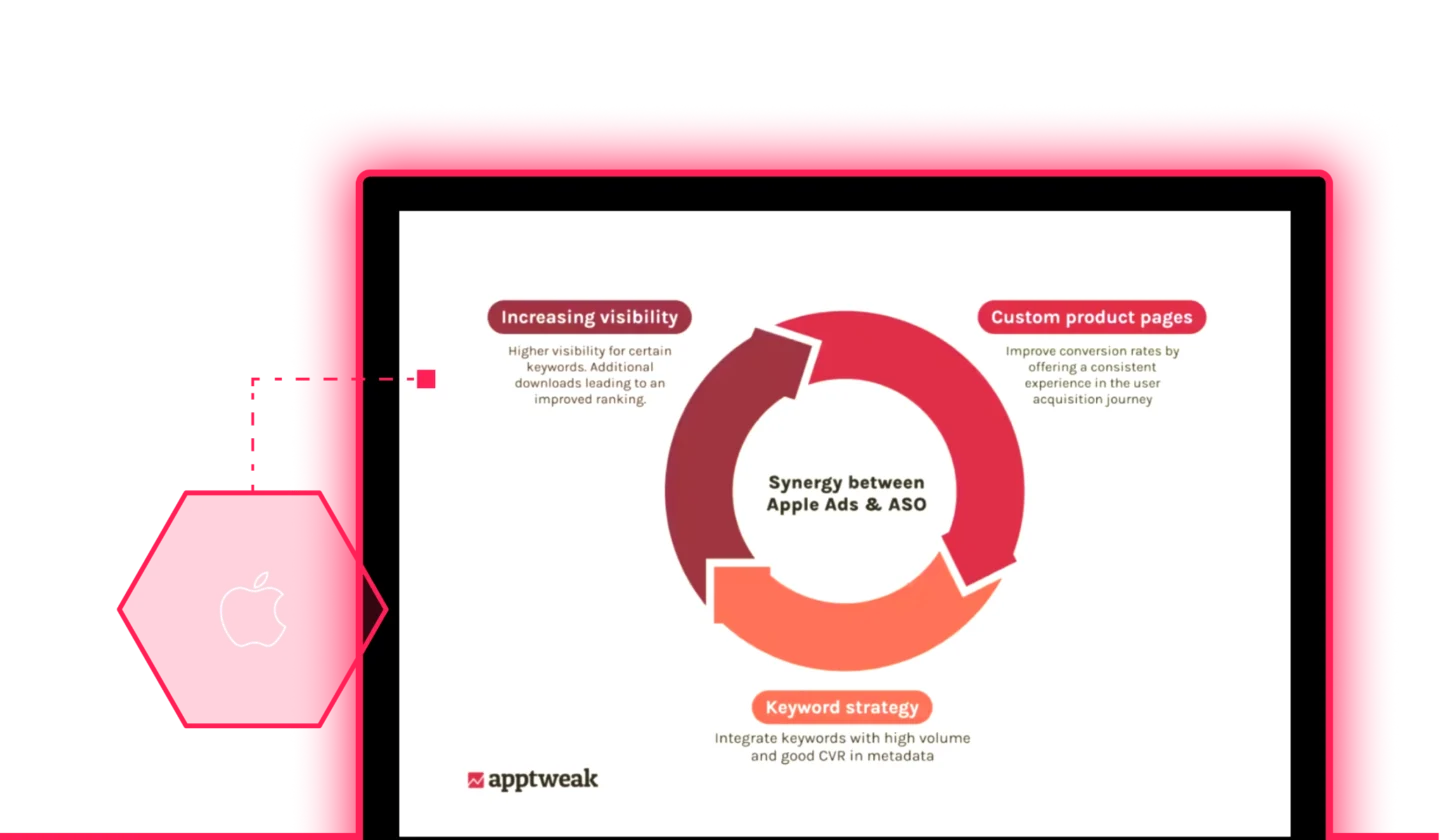
During seasonal events, ASO and Apple Ads reinforce each other in a compounding loop that amplifies both paid and organic performance.
App Store intelligence tools help make this connection clearer by showing how creative changes and keyword coverage influence both visibility and conversion. This shared visibility allows teams to optimize not just for installs, but for overall App Store performance.
Post-install: Measure performance beyond installs
Installs are an important signal, but they are only the beginning of the user journey.
To fully understand Apple Ads performance, teams need to go beyond acquisition metrics and evaluate the real impact of their efforts over time, not just what changed, but what actually drove that change.
This means understanding how campaigns influence overall growth, and distinguishing their impact from external factors such as seasonality or market shifts.
This is where measurement frameworks like incrementality become essential.
Rather than assuming that an increase in installs is directly caused by a campaign, incrementality helps isolate what would have happened without that activity, providing a clearer view of true impact.
In practice, this allows teams to determine whether Apple Ads campaigns are driving additional growth beyond baseline trends, and how paid and organic efforts influence each other.
By grounding decisions in this type of analysis, teams can move beyond surface-level metrics and optimize Apple Ads strategies with greater confidence.
At the same time, attribution platforms like Branch complement this view by connecting campaign activity to downstream behavior and user journeys.
Together, these approaches provide a more complete understanding of performance — from acquisition through long-term impact.
User experience: Align intent from search to in-app experience
While measurement helps teams understand campaign impact, user experience optimization focuses on whether users encounter what they expect after installing the app.
Every Apple Ads interaction sets an expectation, shaped by the user’s search query, the ad they engage with, and the App Store messaging they see on a product page or custom product page.
When these signals are aligned, users can quickly recognize the app’s value and move forward with confidence.
In practice, this alignment shows up when:
- The feature or use case highlighted in search is immediately visible after install
- Messaging in the app reflects what was promised in the ad
- Onboarding reinforces the user’s original intent
When this alignment is missing, friction can emerge, even if acquisition is successful. Maintaining consistency from search to in-app experience helps guide users to relevant content from the start, reinforce their motivation, and communicate value early in the journey.
Solutions like Branch help connect acquisition signals with in-app experiences through deep linking, ensuring users land in the right place after install rather than a generic home screen, and preserving the context of their original search intent from the moment they open the app.
Apple Ads performance isn’t just about driving installs; it’s about translating intent into meaningful engagement.
Improving performance ultimately comes down to connecting visibility before the tap, in the App Store, and after install. Teams that align these signals can make more confident decisions and build strategies that support sustainable growth over time.
Choosing the right tools for Apple Ads to gain full-funnel clarity
Apple Ads performance spans multiple layers, from search intent to App Store conversion and post-install impact. Teams need tools that help close specific gaps at each stage.
This is why your tech stack for Apple Ads should be made of three layers:
- Execution through Apple Ads
- Insight to inform decisions before and during campaigns
- Measurement to evaluate impact across the user journey
Together, these layers create a more complete and connected view of performance.
Native Apple Ads reporting: The foundation
Apple Ads provides essential campaign-level insights, including impressions, taps, cost-per-tap, and installs. Features like search term reports and auction insights help teams manage bids, refine targeting, and allocate budget effectively.
This native reporting layer is critical for day-to-day campaign execution. It allows marketers to monitor performance in real time and make adjustments based on live campaign data.
AppTweak: Insight for pre-tap and in-store clarity
Effective Apple Ads optimization starts with understanding demand, other apps in your market, and how user intent is expressed in the App Store.
AppTweak’s Campaign Manager provides this layer of insight, helping teams make more informed decisions before and during campaign execution.
On the pre-tap side, it enables teams to:
- Identify high-intent keywords through advanced research and clustering
- Understand competitive pressure and share of voice across markets
- Track how search demand evolves over time
Within the App Store, AppTweak adds visibility into the factors that influence conversion, including creatives, metadata, and overall store performance.
By connecting these signals, teams can better understand how paid campaigns and App Store presence influence each other. This makes it easier to align keyword strategy, creative messaging, and product page experience.
AppTweak’s Ad Agent builds on this foundation by turning insights into clear, actionable recommendations. By combining real campaign performance with App Store intelligence, it helps teams identify where to invest, what to optimize, and how to scale more efficiently.
Rather than optimizing campaigns in isolation, teams can make decisions with a clearer view of demand, competition, and conversion, strengthening the feedback loop between Apple Ads and ASO.
Branch: Measurement and user journey visibility
Where insight helps teams make better decisions before and during campaigns, understanding what happens after the install completes the picture.
Installs are an important signal, but they do not fully reflect the quality or long-term impact of a campaign.
Branch provides this layer of measurement by connecting Apple Ads activity to downstream conversions.
Through attribution and cohort analysis with Branch, teams can:
- Understand how campaigns and keywords contribute to user engagement
- Evaluate performance beyond initial acquisition
- Deduplicate conversions across Apple Ads and other ad networks for accurate attribution
- Identify which strategies drive long-term value
Branch also supports journey continuity through deep linking and deferred deep linking, helping align acquisition intent with in-app experience and reduce friction after install.
By adding this measurement layer, teams can evaluate Apple Ads performance more holistically, connecting campaign activity to real user outcomes.
Conclusion
Improving performance in Apple Ads is not about a single optimization, but about building clarity and continuity across the entire user journey.
From understanding user intent before the tap to aligning App Store messaging for stronger conversion and measuring impact beyond installs, each layer contributes to a more complete view of performance. When these elements work together, teams can make more informed decisions and adapt their strategies with greater confidence.
A structured approach that connects execution, insight, and measurement helps ensure that Apple Ads campaigns are aligned with both market demand and user expectations. This not only supports more efficient acquisition, but also creates a stronger foundation for long-term growth.