
The modern user journey is more fragmented than ever, with users engaging across multiple platforms, devices, and channels before they install or convert. This complexity makes it nearly impossible for marketers to justify ad spend, optimize campaigns, and make confident budget decisions.
Fortunately, mobile measurement partners (MMPs) provide the solution: a unified, data-driven foundation for understanding which marketing efforts drive real results across your entire app business.
What is an MMP and how does it work?
MMPs connect marketing touchpoints with app installs and in-app events. A mobile measurement partner serves as an impartial, single source of truth, unifying data from all your channels to reveal which efforts truly drive conversions.
To achieve this, MMPs use two core matching methodologies:
- Deterministic matching: Offers the highest accuracy by using device identifiers to create a direct link between a touchpoint and a conversion.
- Probabilistic matching: Analyzes non-personal signals like IP address and device type to statistically infer attribution when deterministic identifiers are unavailable.
Modern MMPs are built for today’s privacy-first era. They combine deterministic matching with probabilistic modeling and integrations for privacy-preserving frameworks like SKAdNetwork (SKAN). This hybrid approach ensures you receive reliable, comprehensive measurement across all operating systems while respecting user consent and privacy.
Unified cross-platform attribution tracking
Without an MMP, marketers are left to piece together conflicting reports from siloed platforms. Meta Ads, Google Analytics, and Apple Search Ads each use their own logic, often taking credit for the same conversion. This duplication of attribution claims distorts performance metrics, making it impossible to know which channels truly drive results.
MMPs solve this by acting as a single source of truth, de-duplicating conversions and consolidating data from all your paid, owned, and organic channels into one centralized dashboard. This gives you a clean, comprehensive view of the user journey from the first touchpoint through install, purchase, and beyond. By eliminating data silos, you gain the cross-channel clarity needed to make confident budget allocation decisions.
Advanced fraud detection and prevention
Fraudulent installs, click injection, and fake conversions corrupt your attribution data and lead to misguided optimization decisions. However, enterprise-grade MMPs employ sophisticated fraud detection and prevention systems that continuously monitor attribution data for suspicious patterns, analyzing device fingerprints, IP addresses, engagement patterns, and conversion timing to identify and block fraudulent activity in real time.
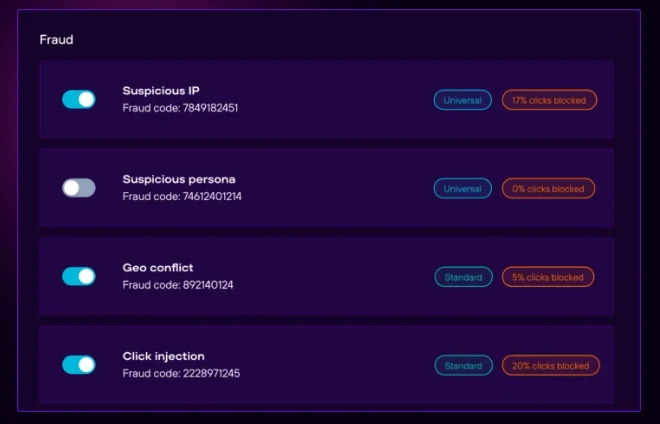
Data contamination from fraudulent conversions can lead you to invest in channels that appear successful but deliver fake or low-value users. Sound fraud protection can help you make confident decisions about budget allocation, creative performance, and channel strategy.
Real-time campaign performance optimization
Real-time data feeds fundamentally change how you manage campaign performance. Rather than waiting hours or days for dashboards to update, you get immediate visibility into install volumes, conversion rates, and engagement metrics. With this, you can:
- Identify underperforming creatives within hours of launch
- Shift budget between channels based on current trends
- Capitalize on high-performing campaigns before conditions change
This agility extends beyond advertising spend. You can monitor email campaigns, organic social posts, paid media, and influencer partnerships simultaneously, adjusting strategy across all channels at once. When a particular message resonates in one channel, you can quickly test similar variations across other campaigns to maximize campaign effectiveness and ROI.
How to choose the right MMP
Your MMP selection should future-proof your measurement capabilities while addressing today’s immediate attribution challenges. Here’s how to separate strong options from weak ones when choosing the right MMP.
Essential attribution features and capabilities
Your MMP should include these core capabilities:
- Privacy-preserving measurement infrastructure with native support for SKAdNetwork and consent management frameworks that maintain attribution quality without sacrificing user privacy.
- Multi-touch attribution modeling that goes beyond last-click to reveal the full customer journey, highlighting a channel’s true contribution to a conversion and user drop-off points.
- Deep linking technology that connects marketing campaigns directly to specific in-app experiences, improving conversion rates for both new and existing users.
- Comprehensive event tracking that captures standard events, like installs, opens, and purchases, and custom events specific to your business model, without additional costs.
- Granular audience segmentation that allows performance analysis by user cohorts, behavior patterns, campaign granularity, and lifetime value.
- API access and data export functionality for integrations with your existing business intelligence tools and customer data platforms.
The most effective MMPs combine these features into a unified solution that eliminates data silos and provides a single source of truth for all marketing performance metrics.
Integration requirements and technical considerations
A successful MMP implementation hinges on its technical integration, often achieved with a few critical steps:
- Embed the MMP’s SDK into your mobile app. This step requires close collaboration between your marketing and engineering teams, and the complexity depends on your app’s architecture (native vs. cross-platform frameworks).
- Establish data compliance and prioritize user privacy. Your MMP should seamlessly support consent management frameworks that accommodate regulations like GDPR and CCPA. It should also integrate with Apple’s privacy technologies, including the ATT framework and SKAdNetwork. Overall, it should handle user consent signals correctly, routing attribution data through privacy-safe channels.
Consider the long-term maintenance requirements. Some MMPs demand frequent SDK updates to maintain compatibility with OS changes, creating a constant drain on engineering resources and attribution gaps. But a stable, backward-compatible solution reduces this overhead, freeing up your developers to focus on your core product.
MMP implementation best practices
A successful MMP implementation hinges on strategic planning. Many teams rush this critical phase, only to face misconfigured conversion events and misaligned attribution windows later. To avoid costly rework and data gaps, create a comprehensive implementation plan before you begin.
Your plan should start with a detailed checklist that covers:
- Channel documentation: List all paid, owned, and organic channels that require tracking.
- Critical event identification: Define the in-app events that signal user value and align with your business goals.
- Attribution window configuration: Establish parameters for click- and view-through attribution based on historical user behavior.
- Fraud prevention setup: Configure rules to block fraudulent activity from contaminating your data.
- Postback integration: Plan the setup for server-to-server postbacks with all relevant ad networks.
- Validation protocol: Create a clear testing plan to validate data accuracy before and after launch.
A well-defined plan also includes a realistic timeline. Factor in time for SDK integration, quality assurance (QA) testing, and a soft launch period to validate data against existing benchmarks. While most implementations take 4 to 6 weeks from planning to full deployment, complex enterprise environments may require more time for compliance reviews and cross-functional alignment.
Setting up attribution windows and models
Attribution windows define the timeframe during which a touchpoint is eligible for credit, typically ranging from 7 to 30 days for clicks and 1 to 24 hours for views. Setting a small window can undervalue campaigns with a long consideration cycle, while an overly generous window can inflate performance and misdirect your budget.
Align your attribution configuration with your business model and the typical user journey:
- For apps that thrive on impulse purchases, a short attribution window and a last-touch model effectively capture the final interaction that drives a sale.
- For apps with a longer research phase, extend windows and conduct multi-touch analysis to ensure early discovery touchpoints receive proper representation in your budget allocation.
Configuring event tracking and conversion goals
An effective MMP hinges on tracking the user actions that matter most to your business. Start by identifying the critical in-app events that signal engagement and correlate directly with lifetime value. For example:
- A retail app would track product views, add-to-cart actions, and completed purchases.
- A travel app would track search queries and confirmed reservations.
- A QSR app would focus on order placements and loyalty enrollments.
What mobile app events to track varies by vertical, but the principle is consistent: prioritize quality over quantity.
Tracking too many events creates data noise that obscures meaningful insights, while tracking too few leaves gaps in your understanding of user behavior. Focus on core events that represent key milestones in your conversion funnel that are predictive of user retention and value.
The technical implementation of event tracking requires close collaboration between marketing and development. Ensure your engineering team:
- Validates event firing in a development environment before deploying to production
- Integrates the MMP’s SDK to fire events at the correct moments in the user journey
- Establishes consistent naming conventions and parameter structures across all platforms
Testing and validating attribution accuracy
Before going live, you must validate your attribution data to ensure every decision is based on reality. The most reliable method is to run small, controlled test campaigns where you can manually verify installs and conversions, then compare these known outcomes against the data reported by your MMP. This baseline validation confirms that your core setup is capturing events correctly before you commit your full budget.
Your validation process should stress-test every component of the user journey. This includes:
- Confirming that deep links work flawlessly across all channels
- Verifying cross-device attribution for users who start on one device and convert on another
- Testing for edge cases that standard QA often misses, such as users clearing their cookies, switching networks mid-session, or experiencing an app crash
Maximizing ROI through MMP attribution data analysis
Attribution data isn’t just a record of installs. It’s a lever for revenue growth. When used effectively, it reveals which campaigns drive high-LTV users, which channels deliver real ROI, and where to reallocate budget for maximum impact.
The key is segmentation. Break down attribution data by campaign, creative, audience, and conversion events to uncover insights that drive better optimization decisions. Top-performing teams operate in continuous optimization loops, shifting spend in real time, testing creatives systematically, and scaling what works based on data.
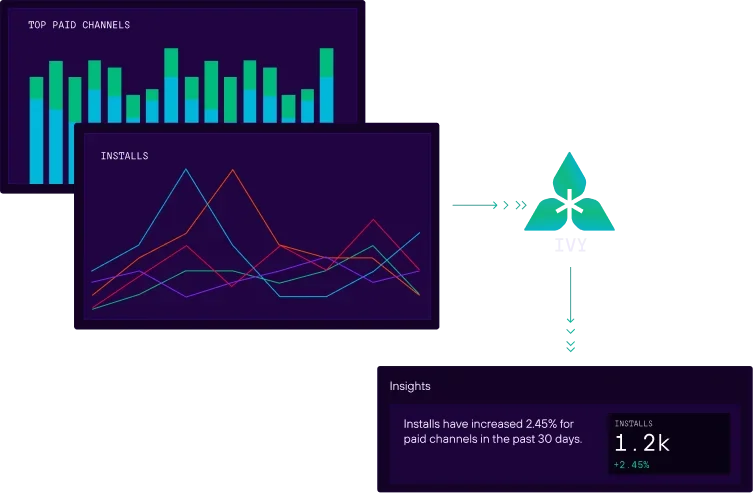
Branch unifies attribution across web, mobile, CTV, and offline touchpoints, giving you a complete view of the customer journey and surfacing opportunities other platforms miss. The result is a shift from reactive marketing to a proactive growth engine. Every decision, from targeting to budget allocation, is driven by measurable impact.
Branch’s Ivy AI can simplify this even further, with personalized recommendations and automation for greater efficiency and stronger analysis.See how Branch Performance gives you the unified visibility and accurate measurement needed to optimize campaigns, maximize ROI, and scale what works.
Frequently asked questions (FAQs)
MMP provides unbiased attribution decisions that consider all platform-specific attribution claims before assigning credit, providing more accurate, comprehensive attribution than platform-specific tracking. Individual ad platforms like Meta and Google use their own attribution logic, which often results in them taking credit for the same conversion.
This self-attribution bias creates conflicting, inflated reports. An MMP solves this by de-duplicating conversions and applying consistent, universal logic across all your channels.
MMPs support multiple attribution models, including last-click attribution through a hybrid approach of deterministic and probabilistic attribution. Advanced MMPs also offer custom attribution windows and waterfalls that let you define specific rules based on your unique conversion paths, campaign strategies, and touchpoint prioritization.
MMPs navigate iOS 14.5+ privacy rules by intelligently combining two attribution methods. When users grant consent via the App Tracking Transparency (ATT) prompt, MMPs use deterministic tracking for granular, user-level accuracy. When users opt out, attribution shifts to Apple’s SKAdNetwork (SKAN) framework or probabilistic attribution models.