

Most marketing teams have figured out how to keep campaigns running. What they haven’t figured out is how to grow without breaking.
MoEngage, Branch, and Moveable Ink surveyed over 600 B2C marketers to understand what happens when you ask teams to scale. The headline finding: 42.86% said data quality and targeting accuracy would fail first if they had to double campaign volume without adding headcount.
Below, we share Branch’s take on three findings that show where the infrastructure breaks: disconnected measurement, underutilized channels, and organizational friction that slows execution.
Attribution clarity is driving a replacement wave
The story marketers are telling isn’t about budget cuts: Only 23.96% of respondents are reducing spend. Instead, there’s a massive replacement wave happening: 52.53% of B2C marketers plan to swap out their email platforms in the next 18 months, with attribution tools close behind at 49.92%.
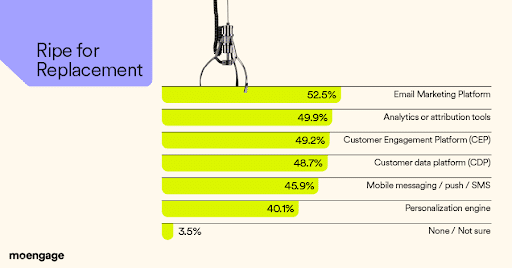
Attribution tools are on the chopping block, but not because of cost. Legacy systems that treat channels as isolated islands can’t meet the needs of modern marketers who need to understand the full customer journey.
Reed Kuhn, head of business strategy at Branch, explains: “Legacy attribution tools silo paid and owned channels instead of showing how they work together. Marketing teams need to see how users move between channels, because that connected data actually improves campaign accuracy on both sides.”
We saw this recently with a major healthcare provider running campaigns across email, direct mail, print, and paid media with no reliable way to measure what worked. Once the team members implemented connected measurement, cost per install (CPI) dropped 97%, and they discovered their direct mail campaigns had generated 1M installs through QR codes. Owned channels they’d been uncertain about suddenly had clear return on investment (ROI).
Branch POV: Attribution must show how channels work together, not just how they perform individually. Connected measurement proves ROI and, more importantly, improves performance.
Mobile channels are underperforming because teams aren’t testing them
Email dominates performance with 68.51% of marketers reporting year-over-year growth. Mobile tells a different story: SMS has the highest stagnation rate. This is because 57.14% of teams continuously test email, while mobile gets treated as a “set it and forget it” afterthought.
The hesitation makes sense. Push and SMS notifications land on home screens, making them feel more intrusive than messages that sit in an inbox. But that visibility is exactly why these channels consistently deliver higher engagement and click-through rates (CTRs) when used well. The opportunity lies in earning that access through precise targeting, seamless deep linking, and proving value with attribution that tracks conversions, not just opens.
Branch POV: Mobile channels deserve the same experimentation cadence you apply to email. Test messaging frequency, timing, calls to action (CTAs), deep link destinations, and creative variations. Measure down-funnel results and use attribution to see what’s actually driving conversions.
Cross-channel silos are slowing organizational speed
Campaign planning is moving quickly for most teams — 64.06% rate their speed as “fast.” But when it comes to cross-functional collaboration, only 42.4% can say the same, making it the lowest-scoring operational area. Teams generate ideas quickly, but then those ideas stall in the handoff between marketing, data, product, legal, and ops.
What’s telling: Only 50.1% identify improving this as a strategic priority for 2026. Instead, marketers are focusing on what they feel they can control: data integration and strategy innovation.
Branch POV: Accepting this friction is a mistake. Marketing and data teams especially need to function as partners, not separate departments filing tickets back and forth. Give marketers direct access to the data they need, establish key performance indicators (KPIs) both teams care about, and suddenly execution can move as fast as strategy. The gap between planning and launching doesn’t need to take weeks.
Building infrastructure that scales
These three insights represent some of the most critical pressure points facing B2C marketers right now, but they’re just part of the picture. The full report also covers AI adoption patterns, channel maturity gaps, and the shift from campaign calendars to real-time personalization.
What ties it all together is a simple reality: The infrastructure that got you here won’t get you to scale. Manual processes, siloed tools, and disconnected data work fine until you need to grow. Then they become the ceiling.
Check out the full Resilient Marketer Report for complete data, expert analysis, and tactics for building marketing operations that scale.