We all trust our friends more than we trust brands. It’s why word-of-mouth marketing is one of the most effective ways to grow a business, large or small.
App marketers figured this out a long time ago and have been finding ways to incentivize users to share their apps ever since. It’s why Spotify periodically offers dollars off its monthly subscriptions if users refer their friends to the app, and why Rakuten rewards its users with cash back when they get a friend to sign up. Branch data shows that these incentivized referrals convert at roughly 70%, and referred users are worth two to three times as much as users from other channels.
They’re one of the best ways for mobile marketers to acquire new users but, as with most things in mobile, referral programs are a bit more complicated than just offering a good incentive.
How do referral marketing programs work?
A mobile referral program rewards existing users for bringing in new ones. A current user shares a personal link with a friend, family member, or follower; the recipient signs up, installs the app, or completes a purchase; and both people typically get a reward for it.
Referral programs generally take one of three shapes:
- Brand-driven campaigns: A company offers an exclusive bonus tied to a partnership or moment, independent of a single referring user, such as a limited-time reward for downloading during a promotional event.
- Friend-to-friend (one-to-one): A user shares directly with people they know and earns a bonus when the referred user installs the app. This is the most common structure and works well for consumer apps with a naturally social use case, like ride-share, food delivery, or fintech.
- Influencer-driven (one-to-many): Creators and affiliates share a referral link or code with their audience, trading reach for a per-referral or revenue-share payout. This structure can scale faster than one-to-one sharing, but it needs tighter tracking since a single link may be responsible for a large share of new installs.
Why the linking experience decides whether it converts
A referral program’s mechanics (who gets what reward, and when) get most of the planning attention. The technical experience gets less, and it’s usually the bigger lever. If a referred user has to install the app and then hunt for the promotion, the discount, or the content their friend shared, most of them won’t bother.
Branch’s data backs this up: referred users convert at 200% to 300% the rate and revenue per user of other channels, but only when the link carries context through the entire path, including through an app install. That’s where deferred deep links come in — they hold onto the referrer’s information and the intended destination while the new user downloads the app, then opens them directly to the right screen the first time they launch it.
How to run a mobile referral program
1. Choose an incentive structure
Two-sided incentives that reward both the referrer and the referred user tend to outperform one-sided ones because they give the new user a reason to act immediately. Robinhood, for example, gives both users a free share of stock when the referred user places their first order.
Keep the reward simple enough to explain in one sentence, and where possible, tie it to real product usage rather than a generic monetary benefit. A ride credit or discount on the first order, for example, encourages users to actually use your app once they’ve downloaded it.
2. Build a referral link that won’t break during the install process
This is where most programs go wrong. Referral links need to take users to the app store, through the install process, then automatically apply the reward once they’ve opened the app. And that process needs to hold up regardless of the channel, platform, or device your users are sharing on.
In practice, that means the link can’t just point to the app store listing and stop there. It has to be a deferred deep link: a link that holds onto the referrer’s identity and the intended destination (a promo code, a specific product, a signup flow) while the new user is off in the app store downloading the app, then hands that information to the app the first time it opens. Standard deep links only work once the app is already installed; deferred deep links are what make the referral survive the gap in between.
3. Promote the program across your channels
There are dozens of ways to promote your mobile referral program once you’ve built the mechanics.
- Surface it in-app with a clear CTA, ideally at a moment tied to a positive product experience (right after a purchase, completed booking, usage milestone).
- Use push notifications for users who haven’t shared yet.
- Use onboarding emails to make new users aware of the program.
From there, let users share referring links everywhere they already interact, like social media, SMS text, and WhatsApp. The goal is to make sharing as low-friction as possible.
4. Attribute clicks, installs, and downstream conversions to referrals
Deferred deep links let you track every click, install, and app open back to the referring user, so you know which users, channels, and messages actually drive growth. This is also how you calculate your app’s k-factor: the number of new users each existing user brings in, which tells you whether the program is compounding or breaking even.
You can also tie downstream user activity, like a purchase or subscription, back to the specific campaign or referral discount that drove it. That’s what helps you sound a little less like, “referrals are working,” and a little more like, “this incentive, on this channel, is worth the payout.”
That same link-level tracking is what makes A/B testing incentives possible. Run two reward structures side by side (a flat discount against store credit, or a one-sided incentive against a two-sided one) and compare conversion rate, referral revenue, and cost per acquisition for each, broken out by the referral link that drove them.
Mobile referral program examples
Dropbox built one of the earliest and most-cited referral programs in tech: users who invite friends earn additional storage space, a reward tied directly to the product itself rather than a generic discount.
Airbnb runs a two-sided referral program where guests can refer hosts and hosts can refer guests. When a referred booking happens, both parties earn travel credit.
Robinhood rewards both the referring user and the referred user with a free share of stock once the referred user places their first order, an incentive that doubles as an onboarding nudge.
Lyft rewards both the existing customer and the referred user with ride credits. The program has been part of onboarding new riders as Lyft has expanded into new markets, pairing a low-cost acquisition channel with an incentive tied directly to product usage.
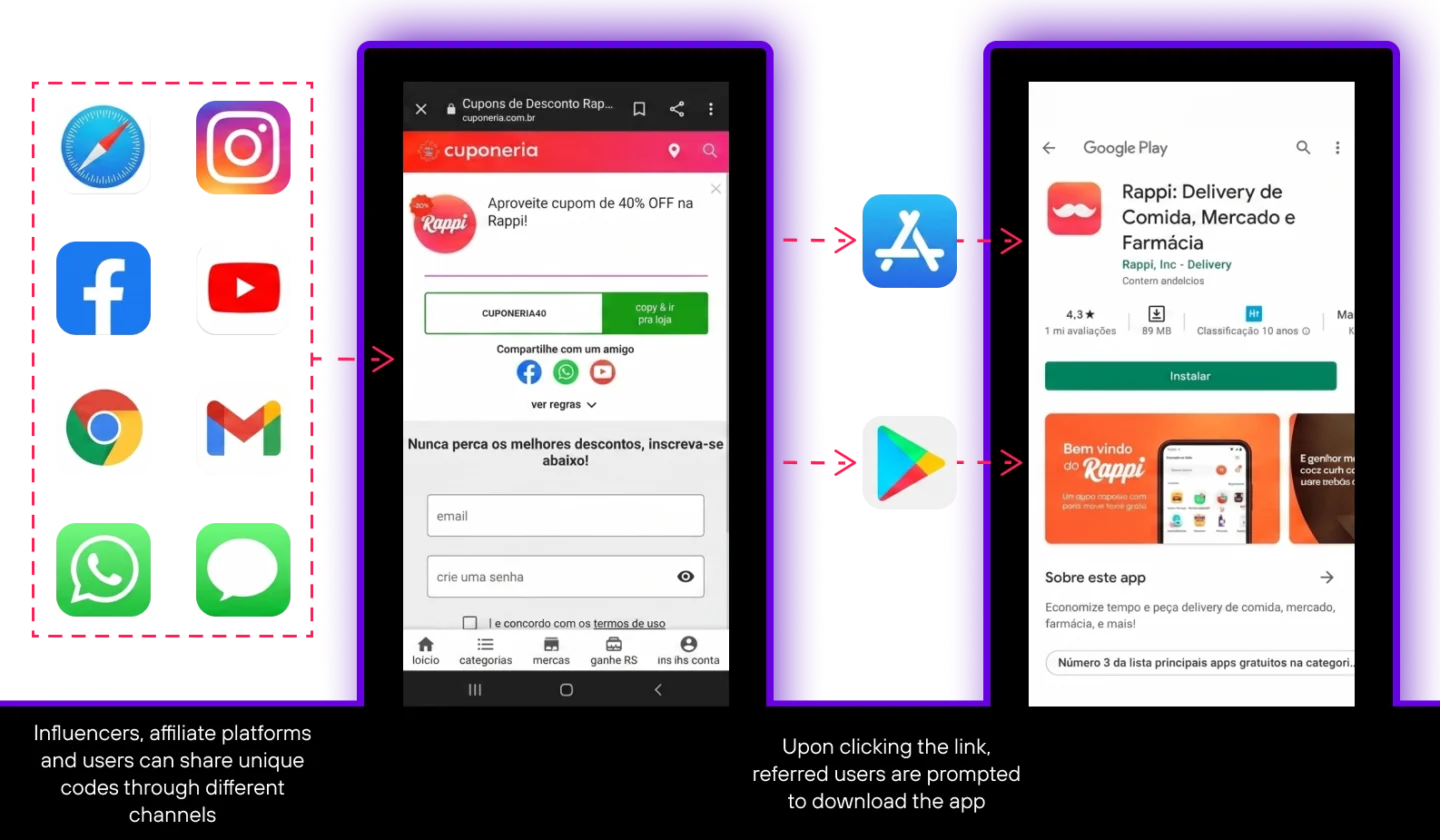
Rappi, the Colombian multi-vertical app, paired referral campaigns with influencer marketing as it expanded into new countries. Influencers, affiliate platforms, and users shared unique discount codes across whatever channel fit them, and clicking the link took the referred user straight to the app store to install.
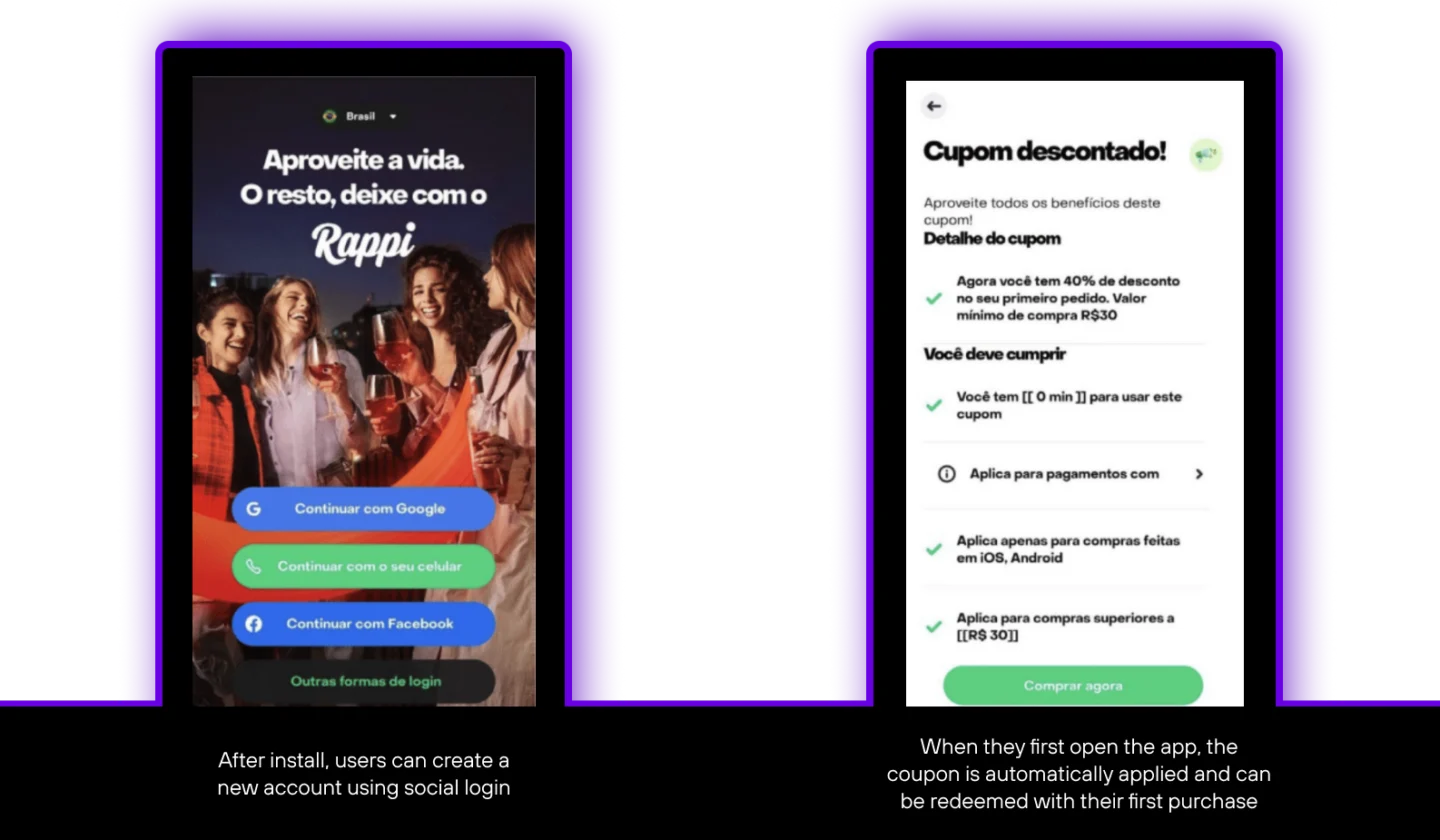
Once the referred user installed the app, they could create a new account with social login, and the referral coupon applied automatically, ready to redeem on their first purchase.
Across the campaign, Rappi saw more than 50 million total app installs, with an average of 50% of new users in newly launched cities coming from influencers and referral campaigns combined.
How does Branch power mobile referral programs?
Branch is a linking and AI-powered measurement platform that helps you land referred users in the exact spot their friend meant to send them, then gives you the attribution data to show the referral actually worked. By tying granular event data to referral links, like trial starts, subscription signups, and purchases, Branch helps you quantify the real value of your referral program, and experiment to see which incentives convert best.
Request a demo to see referral tracking and attribution in action.
A mobile referral program rewards existing app users for sharing the app with friends, family, or followers, typically through a personal referral link that both the referrer and the referred user can earn a reward from.
Each referral link carries a unique identifier tied to the referring user, plus any campaign or discount parameters. If the recipient already has the app, the link opens it directly and the SDK fires a click event and an open event tagged to that referrer ID. If they don’t, the click gets logged by the mobile measurement partner (MMP), then the user is routed to the app store. Android’s Play Store install referrer API can pass that identifier to the app after install so attribution is deterministic and straightforward. Private Relay blocks this kind of behavior on iOS, so marketers rely on tools like Branch NativeLink™ to deferred deep link users into iOS apps and connect the dots between a click and an app open without IP addresses. From there, downstream events like signups or purchases get tagged with that same referred ID through SDK event calls.