Industry
Real estate
Market size
$1.66 billion
About Housing.com
A leading platform in the $1.66 billion Indian proptech market, Housing.com connects homebuyers and renters with developers and brokers in 28 major cities and thousands of towns across India. Now part of the REA Group, the company offers a full range of real estate services, from personalized search and market intelligence to home loans and post-transaction support.
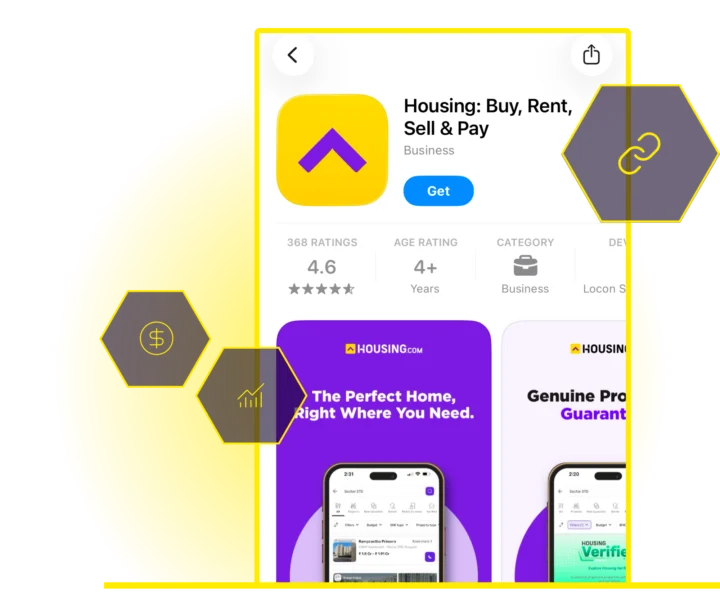
Its mobile app ranks No. 1 in downloads among Indian real estate platforms and is central to how the company grows and serves customers.
Challenge: Finding value beyond acquisition
Housing.com’s app generates between 60% and 70% of its leads, and with better retention, stickiness, and conversion rates than web, it became the natural focus for growth investment. The team went all in on app user acquisition, scaling paid campaigns aggressively to drive installs.
But the results didn’t add up. It saw paid installs climbing, yet overall installs stayed flat. Paid was eating into organic rather than adding to it. An analysis of the broader real estate search market revealed that the pool of new app users had saturated. Housing.com was generating 2.5x more sessions than its closest competitor, but the market simply didn’t have many new users left to acquire.
To keep growing, Housing.com needed to find where incremental opportunity actually existed across its entire ecosystem.
Solution
Housing.com began using Branch in 2022 to get the data it needed to understand user behavior. The team feeds that data into custom Tableau dashboards that track installs, sessions, and conversions across the funnel.
Following the data with deep links
Housing.com uses Branch deep links across all user entry points, including email campaigns, SMS, web-to-app banners, in-app cross promotions, paid ads, QR codes, and push notifications.
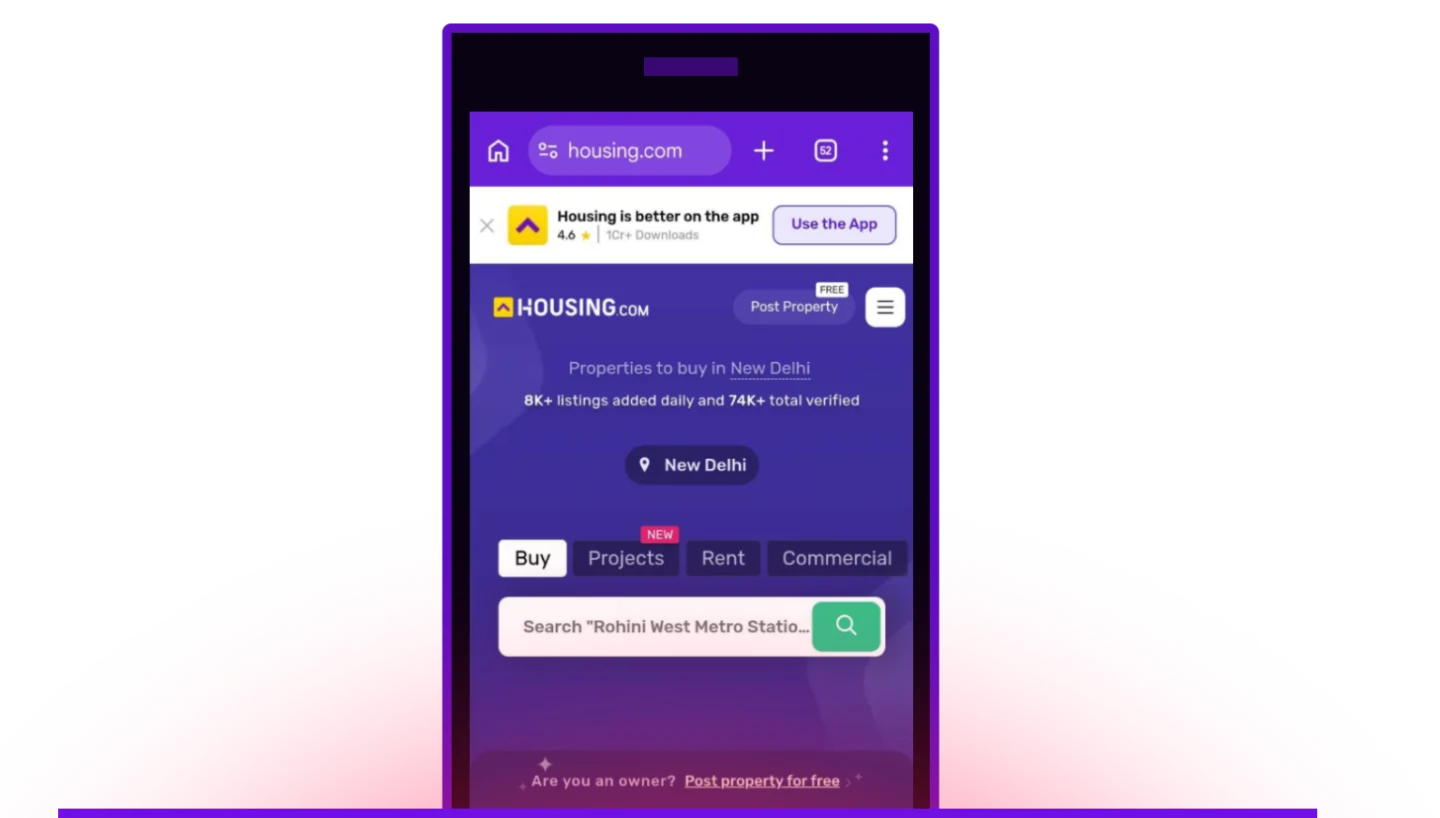
Branch’s mobile web banner prompts Housing.com visitors to continue their property search in the app, using a deep link that carries context from the web session directly into the app experience.
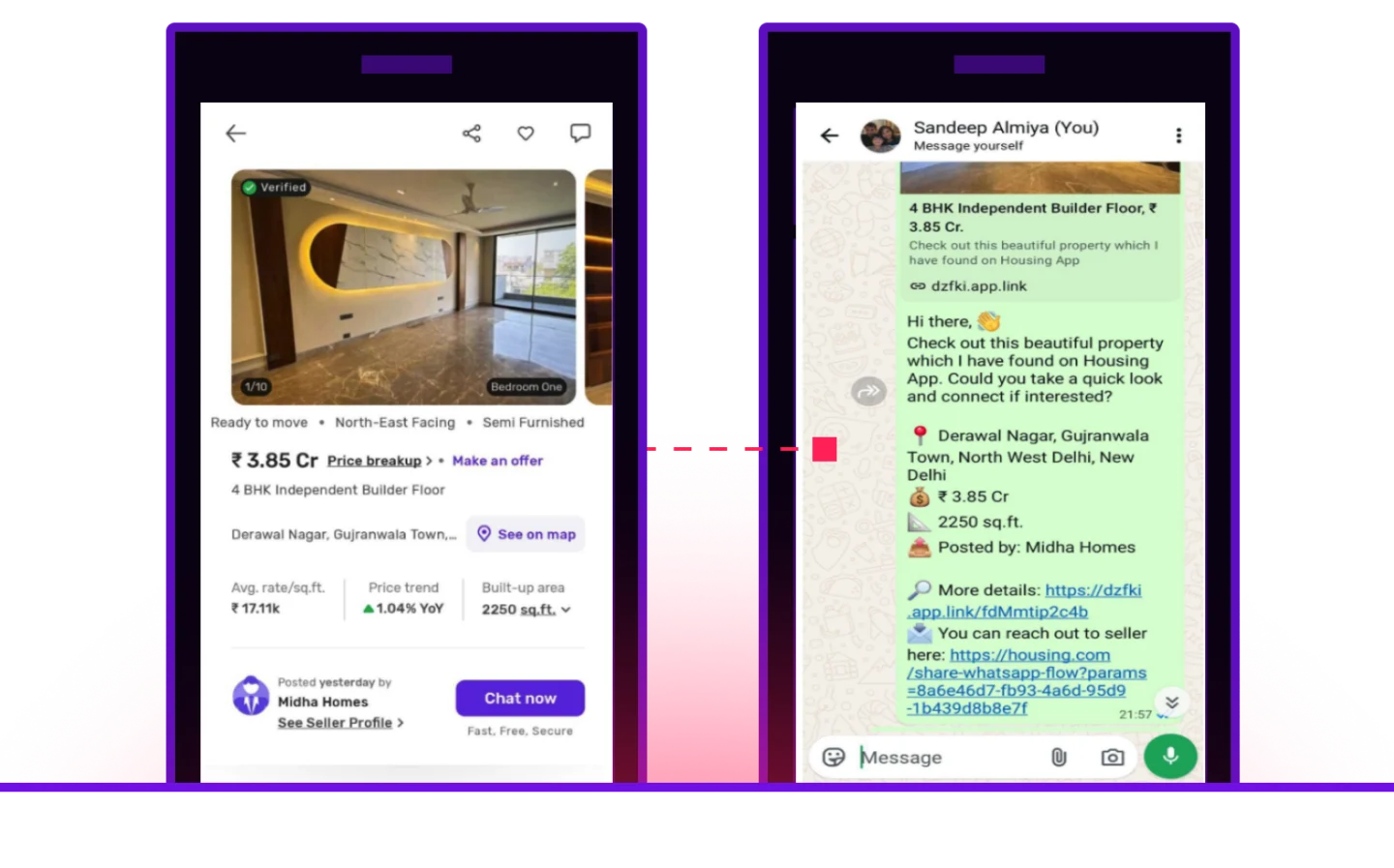
When a user shares a listing, Branch generates a deep link that preserves the full property context, price, location, and seller details, so recipients land on the exact listing, even if they have to install the app first.
By attributing paid and organic channels through a single system, the team gets an accurate view of what’s actually driving installs, sessions, and leads, including how paid and organic interact with each other.
Capturing elusive incrementality
Branch’s user-level data gave Housing.com the ability to feed Branch data into its own Tableau dashboards, so the team could calculate the true cost of incremental installs. That analysis changed the company’s strategy: While the app user acquisition market had saturated, web still offered room to grow. Housing.com reallocated spend accordingly, not as a retreat from mobile but as a data-driven decision about where growth was still available.
The team also uses Branch retention data for annual budget planning. Based on user retention data across its entire ecosystem, the team plans the annual and monthly spends. Throughout the year, the company uses Branch to track the efficiencies of the planned spends and adjust allocation for the following year.
Housing.com doesn’t want to only track efficiencies; it wants to improve them. After optimizing the top and bottom of the marketing funnel, the company identified the events between install and lead submission most correlated with high-value, retained users, then optimized campaigns around those custom events to acquire better-quality customers at a lower cost.
Granular SKAN reporting for iOS growth
Historically, Android has been the primary mobile platform in India. But as that changes, and as Housing.com expands globally, analyzing iOS performance at a granular level is increasingly important.
One obstacle to that granularity is Apple’s privacy framework, including App Tracking Transparency (ATT) and SKAdNetwork (SKAN). Apple has eliminated user‑level attribution by blocking the identifier for advertisers (IDFA) unless users opt in. It provides only delayed, aggregated postbacks.
Housing.com fills these gaps with Branch Predictive Aggregate Measurement (PAM) alongside SKAN reporting. PAM applies predictive modeling to aggregate data for opted-out users, giving Housing.com visibility into campaigns it would otherwise lose. On the SKAN side, Branch centralizes postbacks, deduplicates them against non-SKAN data, and presents everything in a single, aggregated dashboard. Together, these methods give Housing.com a clearer view of iOS campaign performance without relying on device-level identifiers.
Results: Smarter spending, better outcomes
Branch gave Housing.com the data clarity to optimize spend, improve efficiency, and drive higher-quality growth. By shifting focus from vanity metrics to signals that actually predicted business outcomes, the team delivered 30% year-over-year lead growth across the platform.
Where the team once measured success in installs, it now tracks the mid-funnel events and retention signals that translate to real business outcomes and uses Branch data to compare lifetime value (LTV) across app and web users to inform where it invests next.
“No one gives you a pat on the back for increasing click-through rates or app downloads. It’s about translating the analytics into real business outcomes, and that’s where Branch comes in. Branch helped us understand where we were hitting a ceiling on growth, so we could deploy our budget where it actually moved the needle.”

Rahul Mishra
Head of Performance & CRM, Housing.com