

QR codes are everywhere, from in-store placements like storefronts and packaging to offline media like direct mail and out-of-home ads. And shoppers are scanning them: In the Forbes 2025 State of QR Codes Report, 59% of survey respondents said they engage with QR codes every day.
But simply placing a QR code isn’t enough. For retail marketers, the real opportunity lies in tracking every scan, tying it to a conversion, and optimizing campaigns with real-time data.
Most free QR code tools stop at basic scan counts. This guide covers how to go further with platforms like Branch: how QR code tracking works, what tools to evaluate, which metrics matter for retail, and how leading brands are connecting offline scans to measurable mobile revenue.
Why QR codes are back
Once seen as a gimmick, QR codes have made a full comeback, serving as a powerful bridge between offline touchpoints and digital engagement. Thanks to modern tracking capabilities, marketers are starting to treat QR codes as a serious performance channel that can directly impact in-store return on investment (ROI).
The growth of QR codes in marketing
QR codes have gone from novelty to necessity. What started as a pandemic-era contactless solution has become a permanent fixture on retail shelves, in fitting rooms, on receipts, and in windows. Shoppers now expect them, and marketers are catching up, treating QR codes as a distinct performance channel with dedicated budgets and measurable ROI rather than a one-off creative flourish.
Key QR code marketing use cases
QR codes excel at physical-to-digital transitions, making them a natural fit for modern retail marketing campaigns. Common use cases include:
- Driving app downloads from in-store displays and window signage
- Linking offline shoppers to mobile-first product experiences like tutorials, reviews, or loyalty programs
- Sending customers from print ads to personalized landing pages
- Turning physical receipts into post-purchase digital engagement channels
Sophisticated retail teams now integrate QR codes as a distinct traffic source, comparable to email or paid search, with dedicated budgets and performance benchmarks.
Why tracking QR code scans matters
QR code tracking gives retail marketers insight into which QR code placements, formats, or creatives perform best. With the right platform, you can track down to the specific campaign, location, and device and connect that scan to what happens downstream: Did they install the app? Make a purchase? SIgn up for a loyalty program? Most platforms surface both unique and total scans. Unique scans tell you reach; total scans tell you repeat engagement. But the real value is what comes after the scan, which is where attribution comes in.
How does QR code tracking work?
The key to QR code tracking is understanding how to structure your links, what tracking parameters to embed, and which platforms deliver deep enough insight to measure true ROI.
Using UTMs with QR codes
UTM parameters are a straightforward way to add tracking context to any QR code destination link. By appending parameters for source, medium, campaign, and content, you can distinguish between placements in Google Analytics. For retail marketers, UTMs can distinguish, for example, between a scan that came from a checkout counter during a spring sale and one that came from a window display.
For retail marketers using QR codes to drive traffic to web destinations like landing pages or mobile web, UTMs are a useful organizational layer. A seasonal campaign might use a structure like:
utm_source=qr_codeutm_medium=in_storeutm_campaign=spring_saleutm_content=checkout_counter
The limitation is that UTMs are built for web. They don’t carry through app store redirects, which means if your QR code is driving app installs or in-app conversions, UTMs won’t tell you what happened after the scan. That’s where deep linking and mobile attribution come in, picking up where the UTM tracking leaves off and connecting the scan to downstream app activity.
Using deep links to improve user experience
While UTMs tell you where users came from, deep linking controls where they go. For retail marketers driving app engagement, that distinction matters a lot. Without deep linking, a QR code on a product display routes a shopper who doesn’t have your app installed to a generic app store page. If they install, they open to your home screen with no connection to what they originally scanned.
Deep linking fixes that. It preserves context through the app install process on both iOS and Android app stores and enables you to attribute in-app actions, like purchases or trial sign-ups,, to the original QR code scan.
Connecting QR code scans to conversions
Scan volume is a vanity metric if your analysis stops there. The real value of QR code tracking is connecting scans to downstream conversions, but most basic QR code tools fall short. Advanced attribution platforms like Branch provide real-time dashboards to analyze post-scan behavior. You can track the full user journey from the moment a shopper scans a code in your store to the in-app purchase they complete two days later and tie it back to the exact placement, campaign, and creative that started it.
Best tools for QR code tracking
For retail marketers, choosing the right QR code tracking platform depends on your needs. Key factors to evaluate include attribution capabilities, customization, and analytics granularity — all of which determine how effectively you can connect in-store engagement to online conversions. Here’s how the main options stack up.
1. Branch
Branch is an enterprise-grade deep linking and attribution platform that enables retail marketers to create branded, dynamic QR codes built for offline-to-online customer journeys. Unlike basic QR code tools that only capture scan counts, Branch connects every scan to real business outcomes, including app installs, in-app purchases, or loyalty program sign-ups.
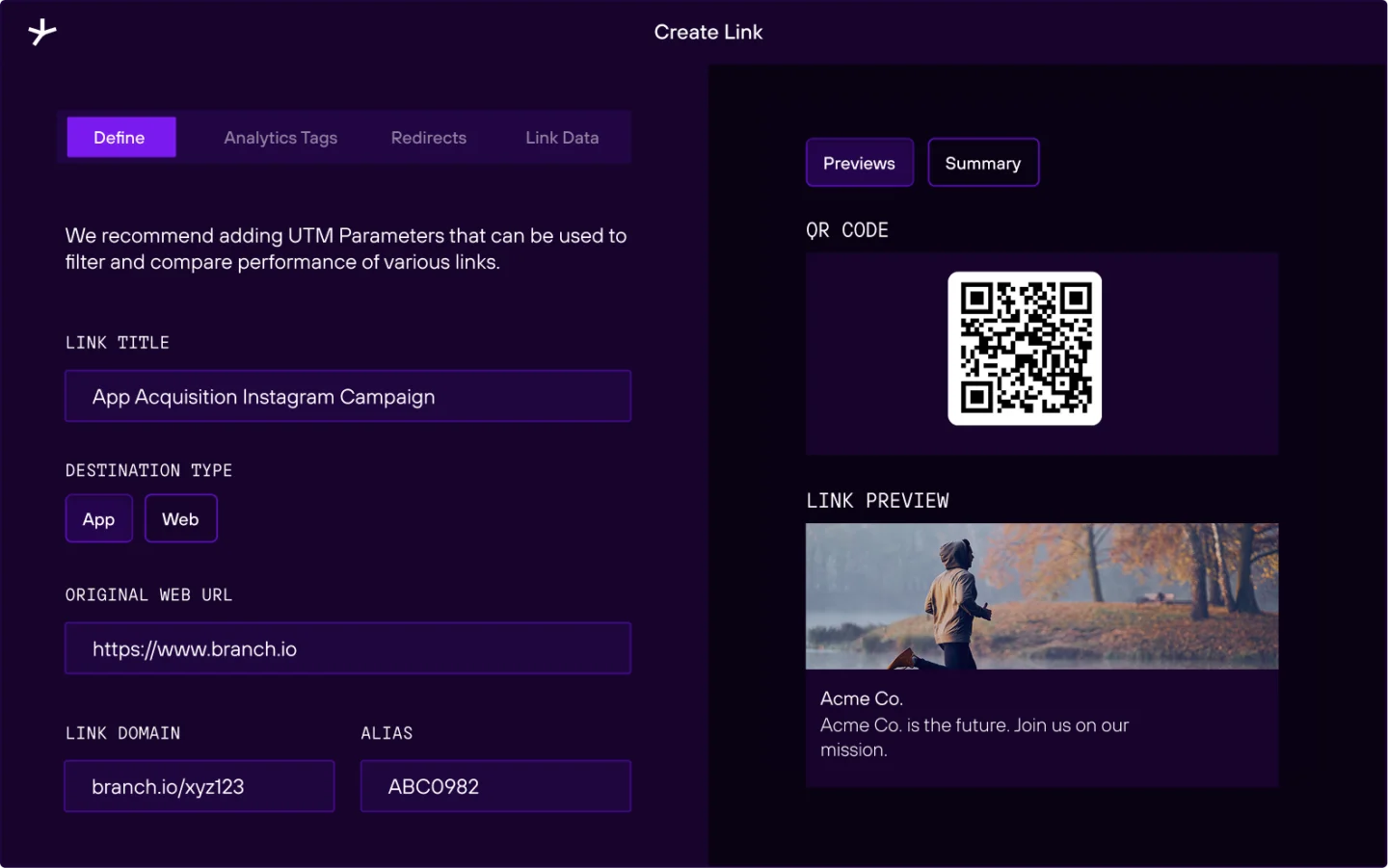
What sets Branch apart is its ability to tie together web, mobile, desktop, and offline engagements in a unified dashboard. You’re measuring impact across the entire user journey, from in-store signage to post-purchase behavior.
Key capabilities for retail marketers:
- Dynamic QR codes: Update destination URLs or redirect logic at any time in the Branch platform without changing or reprinting the physical code — critical for seasonal promotions, limited-time offers, and inventory changes.
- Deep linking through install: QR code scans route users directly to specific in-app content on iOS and Android. For users who don’t have the app yet, deferred deep linking preserves the original scan context through the install process so they land exactly where they scanned to go.
- Guaranteed attribution: Branch ties every scan to downstream in-app activity — like purchases, sign-ups, and opens — so you can calculate true in-store ROI rather than relying on scan counts alone.
- Cross-channel comparison: View QR code performance alongside your other marketing channels in a single Branch Dashboard, so offline and digital campaigns are measured on equal footing.
- Enterprise scale: Generate QR codes programmatically via API or a software development kit (SDK) to handle high-volume campaigns without additional developer overhead.
Considerations: Branch offers two entry points. We designed Branch Activation for web-based campaigns with minimal onboarding — no SDK required — and it gives teams a fast path to custom QR codes with click and scan analytics. For advanced app deep linking and full-funnel attribution, you can combine Branch Activation with Branch’s Engagement or Performance products, which require SDK integration.
Best for: Retail marketers who need sophisticated attribution across complex customer journeys and want to measure the true ROI of in-store QR campaigns alongside other digital channels.
2. Bitly
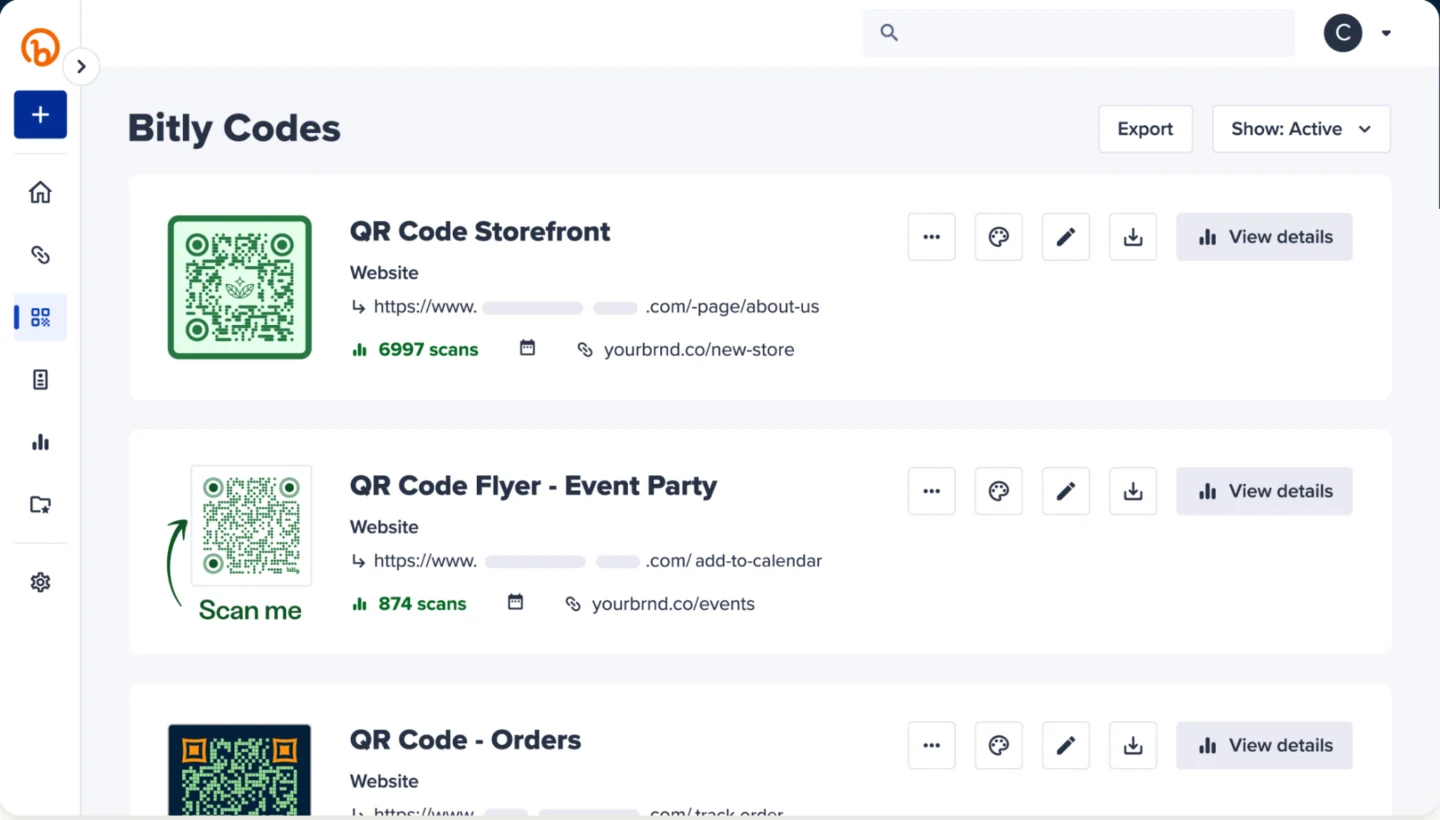
Bitly is a widely used link management platform that combines URL shortening, QR code generation, and analytics to help retail marketers connect offline experiences with online engagement. For teams measuring foot traffic, scan patterns, and basic campaign performance from in-store promotions, Bitly offers an accessible entry point.
Key capabilities for retail marketers:
- Dynamic QR codes: Create customizable, dynamic QR codes that allow destination updates without reprinting, so in-store signage always links to ongoing promotions.
- Bitly Analytics: Track QR code scans in real time, including volume, location (city/region), device type, and time.
- Location-based QR code tracking: Generate unique QR codes per store location to track engagement by region, compare performance across sites, and refine localized promotions.
Considerations: Advanced customization, dynamic QR codes, and detailed analytics require a paid plan. Bitly’s deep linking support is limited, so retail campaigns focused on driving app installs or in-app conversions will likely need a separate solution. Analytics cover click and scan metrics but don’t extend to lifecycle or attribution insights. Link and QR code volume determine pricing, which can add up for high-volume retail campaigns.
Best for: Retail marketers running web-destination QR code campaigns who need straightforward scan tracking and are comfortable integrating with other tools for deeper attribution
3. QRCode Monkey
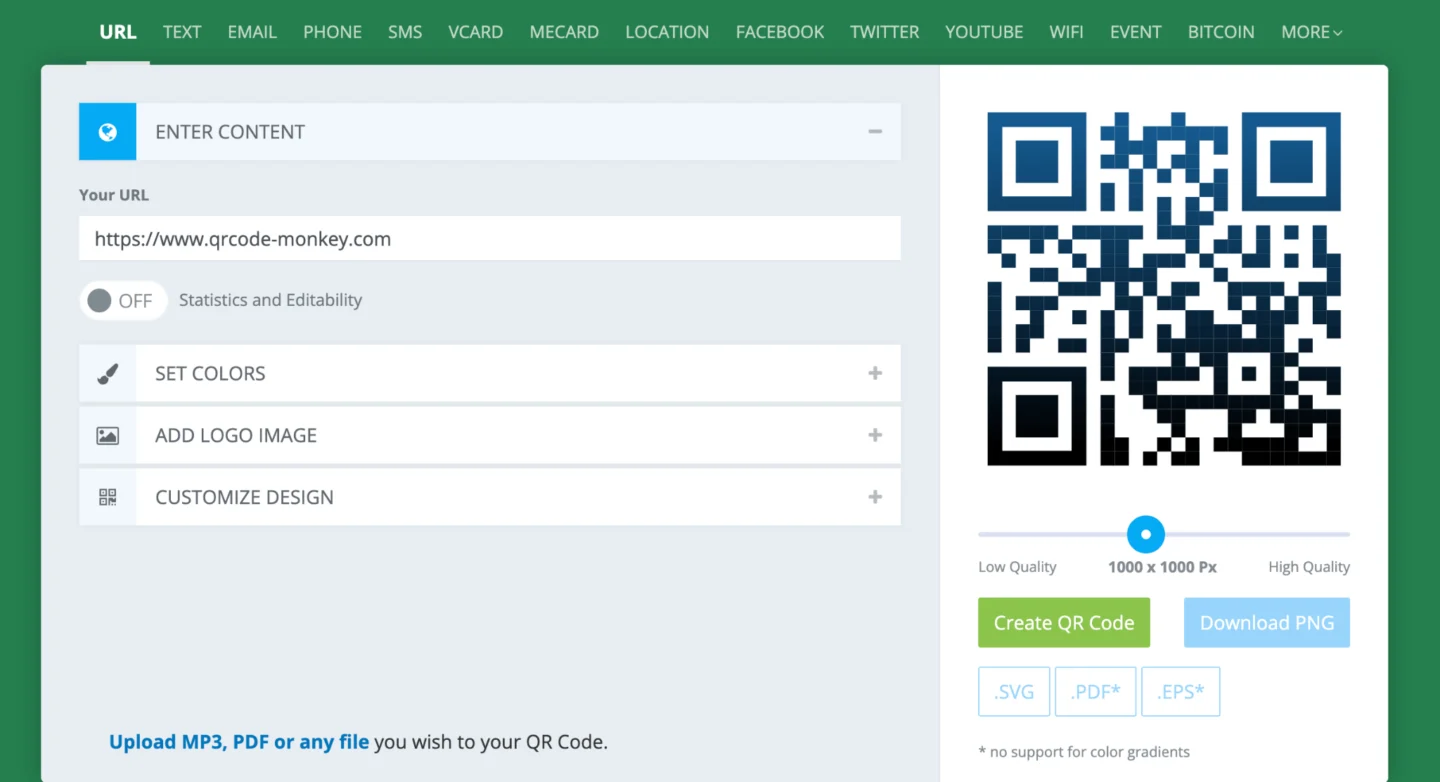
QRCode Monkey is a free QR code generator that prioritizes visual customization and high-resolution exports, making it accessible for retailers integrating QR codes into in-store materials and promotional displays.
Key capabilities for retail marketers:
- Unlimited customization options: Tailor QR code appearance with custom colors, gradients, logos, and adjustable corner shapes.
- High-resolution export formats: Print QR codes at any scale without quality loss with vector exports (SVG, EPS, and PDF).
- User-friendly interface: Intuitive design tools and preview functionality quickly generate professional QR codes — no design skills needed.
Considerations: QRCode Monkey generates only static QR codes without built-in analytics, scan tracking, or location data. Destination URLs can’t be changed after printing, which limits flexibility for seasonal promotions or campaign pivots.
Best for: One-time, design-focused QR codes where the destination is fixed, such as permanent in-store signage or product packaging with stable URLs.
Key metrics to track with QR codes in retail
To drive real ROI, retail marketers need to track metrics that connect physical engagement to digital outcomes and reveal which placements, campaigns, and creatives actually move the needle. Here are three to prioritize:
Scan-to-conversion rate: Scan-to-conversion tracking connects the initial QR code interaction to valuable downstream actions, like app downloads, purchases, or loyalty program sign-ups.
Location-based performance analytics: By generating unique QR codes for each store or in-store placement, you can compare performance across locations and optimize your strategy at scale. This data reveals which environments drive the most engagement.
Customer journey attribution: Shoppers rarely convert in the same session they scan. A customer might scan a QR code on a shelf talker, install the app later that evening, and complete a purchase the next day. Customer journey attribution connects those dots so you can measure true in-store impact, not just last touch.
QR code best practices for retail marketers
QR codes are only as effective as the strategy behind them. For retail marketers, that means thinking carefully about placement, how codes connect offline and online experiences, and what happens after the scan.
Iterate in-store and packaging placement strategies
A QR code’s placement directly impacts its performance. To optimize performance and measure ROI, follow these best practices:
- Test placements: Use unique, trackable QR codes for high-visibility locations, like checkout counters, product displays, shelf talkers, and packaging, then compare performance data and identify which placements drive the most engagement.
- Drive post-purchase value: Use QR codes on packaging to facilitate warranty registrations, loyalty program sign-ups, or access to how-to content.
- Use clear calls to action (CTAs): Tell users what they’ll get by scanning. A code offering “20% off your next purchase” will always outperform one with no context.
- Test before you print: Make sure the code is large enough to scan from a comfortable distance, and verify it works across multiple devices before it goes on physical materials.
Use QR codes to bridge offline and online retail experiences
QR codes turn in-store interactions into measurable digital actions by connecting physical touchpoints to trackable online outcomes. Attribution platforms like Branch measure the entire post-scan journey across web, app, and in-store environments so you can see which offline placements drive the most valuable online behaviors.
Learn more about this approach in Branch’s guide to creating and measuring QR codes.
Optimize the post-scan user experience
The post-scan experience determines whether a customer converts or bounces. To maximize conversions, use deep linking to direct users to relevant in-app content, such as a specific product page or a limited-time offer, rather than a generic homepage.
For users without your app, platforms like Branch preserve the original scan’s context by routing them through the app store and to the correct in-app screen after installation. To further improve performance, ensure your landing pages are mobile-optimized and load quickly, then continuously test variations to see what drives the best results.
Explore QR code customization and campaign insights to see how leading retail brands optimize the end-to-end scan experience.
How retail brands drive growth with QR code tracking
Max Fashion, a retail brand with 650+ stores across 19 countries, had a QR code problem that will sound familiar: one code for every store, no way to track individual performance, and staff with no incentive to drive scans. With Branch, it rebuilt the program from the ground up: generating unique QR codes for each of its 15,000+ store employees, with commissions tied to the app installs each code drove. That single change transformed QR codes from a passive in-store asset into an active sales channel.
The results were immediate. QR codes drove 15% of total app installs during the campaign period, contributing to a 92% increase in app installs and 85% growth in orders directly linked to QR code-driven installs year over year. Customer acquisition costs dropped 10%.
The attribution data Branch provided was what made it possible. Max Fashion went beyond just knowing how many scans happened to knowing which employee, which store, and which campaign drove each install, purchase, and app open.
Turning in-store scans into measurable revenue starts with the right tracking infrastructure. Create trackable QR codes with Branch and connect every offline placement to the installs, purchases, and in-app events it drives.