Attribution is crucial in making, analyzing, and justifying marketing spend decisions. In addition to selecting an effective analytics tool, you need to choose the attribution model that most accurately gives each campaign, channel, and partner credit for the customer conversions it drives. Four commonly used mobile measurement frameworks assign 100% credit for a customer conversion to:
- First-touch attribution: the ad, link, or channel responsible for the user’s first “touch” with the brand.
- Install-touch attribution: a user’s last touchpoint before installing the app.
- Last-click attribution: the ad, link, or channel the user clicked on just before converting.
- Last-touch attribution: the click or impression that occurred just before conversion.
If the conversion event you’re measuring is installation of an app and the last customer touch is a click, then install-touch, last-click, and last-touch attribution will all point to the same channel. If that was also the user’s first interaction with your brand, first-touch attribution will return the same answer as well. In many other scenarios, the different attribution methods will return different results.
Mobile conversions also encompass user actions such as making a purchase within an app or on a website, signing up for a newsletter, downloading a white paper, booking a demo, etc. Which channel gets credit for these user actions can vary depending on which attribution model you use.
How last-touch attribution works
Mobile measurement partners (MMPs) use deep linking technology and measurement tools to collect and analyze mobile advertising data throughout the user journey. They provide marketing teams with an aggregated view that offers powerful insights into ad performance across media sources, publishers, and campaigns. The attribution model an MMP uses can determine how accurate those insights are.
Last-touch attribution assigns credit for a conversion to the most recent touchpoint before that conversion happened. Consider a user who clicks a Facebook ad and installs the Branch Monster Factory app, but doesn’t take any further action. A few days later, an ad on X brings them back into the app, and they start a free trial. A subsequent email campaign then prompts them to convert to a paid subscription.
The Facebook ad clearly deserves credit for the install. But if marketers are measuring free trial starts, their MMP should credit X with that conversion, since the X ad was the user’s last touchpoint before they took that action. Likewise, if the paid subscription is the conversion event marketers care about, their MMP should credit the email campaign, since it was the last touchpoint before that conversion.

How last-touch compares with other single-touch models
Last touch vs. first-touch attribution
By contrast, first-touch attribution gives credit for all conversion events to the user’s first interaction with the company’s brand. This approach helps identify which channels introduce customers to the brand, but it doesn’t show which later activities influenced conversions. I usually attributes too much credit to the channel that brings the customer into the funnel, while ignoring activities that occur later in the user journey.
Suppose the user in our last-touch example viewed a Google ad before the Facebook ad that led to the Branch Monster Factory app install. That Google ad was the user’s first interaction with the brand, and although it didn’t lead directly to any action, it built brand awareness.
First-touch attribution would give Google credit for all subsequent interactions with the brand, including the install, registration, and subscription, while giving Facebook, X, and the email campaign no credit.
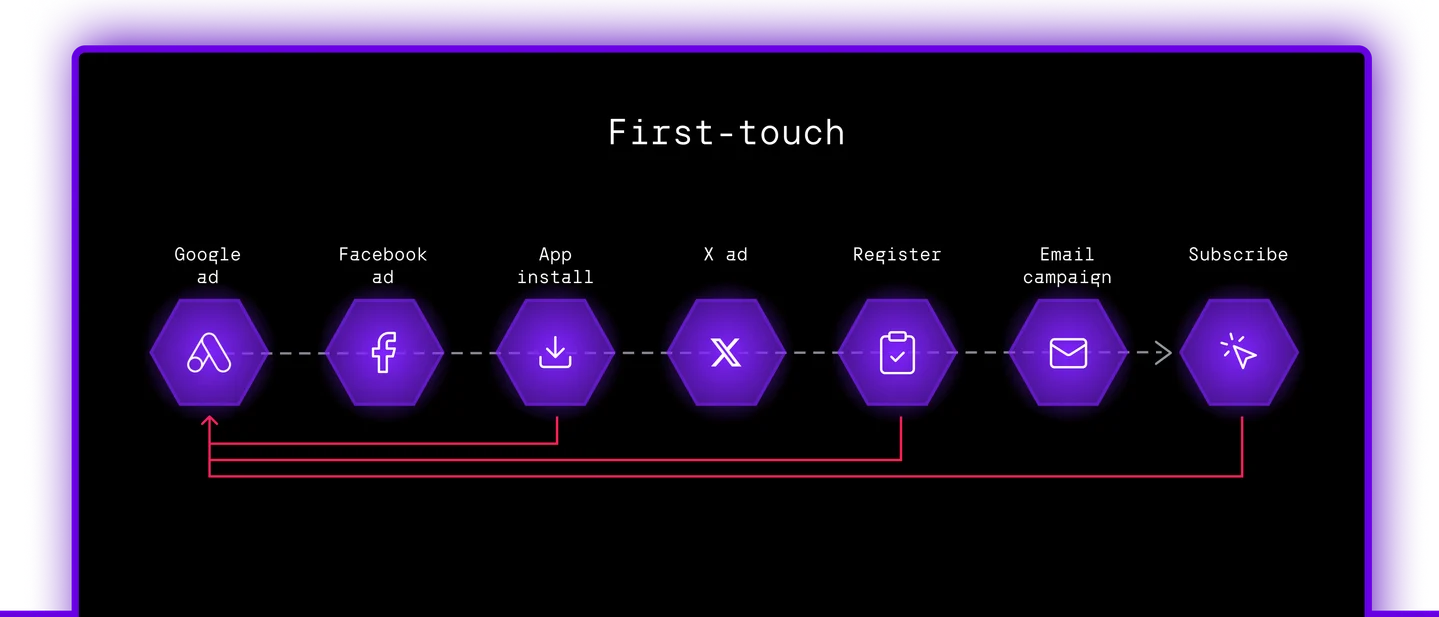
If the marketers in this example receive first-touch attribution data from their MMP, they’ll think one Google ad impression drove every step in the customer journey. If the pattern repeated across many user journeys, they might direct all their resources into Google ads and cut off spending on Facebook ads, X ads, and email campaigns, even though those channels more successfully drive registrations and subscriptions.
Last-touch vs. install-touch attribution
Relying on install-touch attribution creates similar challenges. It gives all the credit for a user action to the user’s last touchpoint with the brand prior to the install. The bias this creates toward install-focused ads comes at the expense of engagement ads or owned and earned marketing activities.

For some companies, such as gaming businesses, the app install may be the end goal of all marketing. In this case, install-touch attribution might be the right model. Most organizations don’t want an app install to be the end of the user journey.
An install doesn’t mean a customer will start, or continue, using it. That’s why most marketers also emphasize the activation and retention of users in measuring lifetime value (LTV). If you care about what’s driving your users to act beyond the install — whether that’s engaging with your app in certain ways or purchasing your products — then last-touch attribution is more useful to you than first-touch or install-touch attribution.
Last-touch vs. last-click attribution
Although last-touch and last-click attribution are similar, there’s a key difference: When crediting a particular channel with a user action, last-touch attribution includes impressions rather than just clicks.
Sometimes clicking through from an ad that leads directly to a conversion event is the user’s last touch before taking action. In other cases, reading a review or seeing a social media post might be the user’s last experience of the brand before conversion.
Imagine that the user in our example clicks through from a Facebook ad to install Branch Monster Factory. They ignore the app for a few days without taking any additional action, until they see an X ad that convinces them to register and start using the app. A few days after that, they receive a targeted email encouraging them to subscribe to the app newsletter. They click through from the email to subscribe.
Last-touch and last-click attribution align on both the first interaction and the last. With either model, Facebook gets credit for the install and the email campaign gets credit for the subscription. With last-click attribution, credit for the user’s registration would go to Facebook rather than X. At scale, using last-click attribution might convince marketers to cut off spending on X, even though the X ad was a crucial step in the user’s journey with the app.

The debate between first-click and last-click attribution mirrors that between first-touch and last-touch attribution. The difference is that click-based models give attribution to any impressions that don’t result in a click.
Why install-touch gets mistaken for last-touch attribution
Last-touch attribution is one of the most common attribution models, especially in mobile advertising. Many MMPs that say they offer “last-touch attribution” actually specialize in install-touch. They use reengagement and reattribution windows that, depending on how those windows line up, may pull post-install events back to the original install source.
Using this false definition of “last-touch” might lead you to double-down on the channel that precedes the install while canceling campaigns that drive post-install conversion activities. When you eliminate post-install touchpoints, you see a drop in your app’s performance because fewer users are engaging after the install.
Early in mobile marketing, the install was marketers’ only focus. Once they accomplished a download, they didn’t worry about whether users came back to the app. Phones have many apps that users never open. You need customers to continue to interact with your app, even after the install. That requires true last-touch attribution. Branch attributes each install or post-install conversion to the channel that drove that specific event, without applying a reengagement window or reattribution logic that pulls later events back to the original install channel.
Last-touch vs. multitouch attribution
Most user journeys include many touchpoints in which the user sees, learns about, or interacts with the brand. Multitouch attribution splits credit for conversions among all those user touchpoints.
- Linear attribution splits conversion credit equally among touchpoints. In our Branch Monster Factory example, Google and Facebook would get equal credit for the install. Google, Facebook, and X would equally divide credit for the registration. All four channels would receive the same credit for the subscription.
- Time-decay attribution spreads credit over all a user’s touchpoints with the brand, giving more credit to the most recent touchpoint, while giving less credit to the first touchpoint.
- U-shaped attribution gives the most credit to the first and last touchpoints, while giving less credit to touchpoints in between.
Other multitouch approaches include position-based attribution, which assigns more credit to select stages of the user journey. W-shaped attribution emphasizes key milestones such as first touch, lead creation, and opportunity creation. Data-driven attribution uses observed conversion data to estimate how different touchpoints contribute.
Why multitouch attribution is hard to do well
Multitouch attribution sounds like the better choice, but most teams run into trouble once they try to put it into practice. First, ad networks still bill performance campaigns on last-touch. Even if you can see every touchpoint and divide credit between them, you still have to pay for the last one.
Second, you have to pick a model, and there are a lot of them. Each one splits credit differently, and when a journey includes a dozen touchpoints, the output gets hard to make decisions from. Third, privacy changes have made it harder to connect touchpoints across devices. Keeping a record of every touchpoint for every user requires sophisticated identity infrastructure. For most teams, the complexity outweighs the benefits.
Branch’s approach to mulittouch attribution looks at assist and influence. It keeps things manageable for marketers by applying a linear model to the last three touchpoints before a conversion. You see which channels help drive the outcome without trying to divide credit along every step of a complicated journey. In our example, it would show Facebook, X, and the email campaigns as the channels that led to the subscription.
Advantages and limitations of last-touch attribution
Because it credits each conversion to its own most recent touchpoint rather than defaulting everything back to the install source, last-touch attribution is generally more valuable than other attribution models.
It’s true that last-touch attribution measures just one point in time, which means that it doesn’t give credit for a conversion event to campaigns that played a lesser role in the user journey. However,by emphasizing the closest touchpoint to the conversion event, it helps you understand, and invest your resources in, the channels that are driving both pre-and post-install.
How Branch combines last-touch and multitouch insights
Unlike other MMPs, Branch offers true last-touch attribution, crediting every conversion to the channel that actually drove it, regardless of which channel drove the original install. If a user installs after a TikTok ad, then returns two days later through a Facebook ad or an email to add to cart, register, or make a purchase, that channel gets the credit. Install-touch attribution is also available, along with cohorting for enhanced install-touch analysis.
Some marketers use install-touch as a shortcut for estimating the lifetime value of users a channel or ad partner brought in. With Branch, you can build an acquisition cohort based on an install and view its LTV, giving you an install-touch view for campaigns you’re otherwise measuring through last-touch, without defaulting every downstream conversion back to the install source. Comparing that delta against your last-touch results shows you the value of crediting each conversion to the channel that actually earned it.
Branch also goes beyond last-touch to show which channels helped move the customer toward a conversion. Funnel Analysis surfaces the assist and influence channels that came before the final touchpoint. Used together, last-touch attribution and Funnel Analysis show you both the channel that earned credit for the conversion and the ones that helped make it happen.
Want a clearer view of what’s driving your conversions? Talk to our team.
Last-touch attribution gives 100% of the credit for a conversion to the customer’s last touchpoint before converting. That touchpoint can be a click or an impression.
Depending on where the customer is in their journey, the accuracy of other attribution models, such as install-touch attribution, varies widely. The benefit of true last-touch attribution is that whether you’re looking at installs,
Yes. Branch uses last-touch attribution by default and offers Funnel Analysis, which applies a linear model to the last three touchpoints before a conversion. It shows which channels assisted and influenced the outcome.