

Fintech apps pay some of the highest costs per install (CPIs) in mobile; Mapendo’s 2025 Cost per Install report puts the financial category at the top of every vertical it benchmarks. That payout premium makes fintech a disproportionate target for install fraud, and the consequences extend well past wasted budget. Fraudulent installs corrupt the customer intelligence behind risk models, know your customer (KYC) and anti-money laundering (AML) records, and regulatory reporting, creating compliance vulnerabilities that invite scrutiny.
The attacks split into two distinct categories. The first is fabricated installs: bots, emulators, and device farms generating install events with no real user behind them. The second is attribution hijacking, where the install is real but a fraudster steals credit for it. Both corrupt your acquisition data through different mechanisms that require different defenses. Treating them as one undifferentiated problem is why most fraud strategies fall short.
Because fraud detection is built into the attribution platform rather than layered on top of it, suspicious installs get flagged before they’re ever credited to a paid channel, with no reconciliation lag and no separate vendor handoff.
Understanding install fraud in fintech
Install fraud splits into the two categories we just covered, fake activity and attribution hijacking, and each one operates through several distinct attack vectors. Here’s how the most common ones work and which category they fall into.
Click injection and click spamming
Click injection and click spamming are two of the most pervasive forms of attribution hijacking. Both click fraud methods manipulate the attribution window to steal credit for legitimate user installs through fundamentally different mechanisms.
Click injection exploits Android’s install broadcast system by listening for app installation events and injecting a fraudulent click milliseconds before the install completes. This allows fraudsters to claim attribution credit for organic installs they had no role in generating, diverting your marketing budget away from channels that actually drove valuable customer acquisition.
Click spamming, or click flooding, takes a volume-based approach, generating massive numbers of clicks from real devices without any genuine user intent. Fraudsters flood attribution systems with clicks across thousands of device IDs, betting that some percentage will eventually install your fintech app organically. When they do, the fraudster’s recent click receives attribution credit, contaminating your data with false signals about which channels drive real customer engagement.
Both tactics look legitimate in basic dashboards. The tells, which include impossibly short click-to-install times, abnormal click volumes, and statistical anomalies in conversion rates, only surface in sophisticated detection systems.
SDK spoofing and device emulation
SDK spoofing is the most technically sophisticated form. Fraudsters reverse-engineer attribution protocols and send fabricated install data directly to measurement platforms, with no real device and no real user behind it, just synthetic signals designed to trigger payouts.
Device emulation takes this further by creating virtual device environments that mimic legitimate user behavior. Fraudsters use emulators and device farms to simulate hundreds or thousands of unique devices, each appearing to install your fintech app with:
- Realistic device identifiers
- IP addresses
- Behavioral patterns
When you’re paying $50–$200 per install for qualified banking or investment app users, bad actors have strong financial incentive to perfect their techniques.
Geomasking and geo-spoofed installs
Geomasking is when fraudsters use VPNs, proxies, or location spoofing to disguise where an install actually originated. The motive is cross-border arbitrage: deliver installs from low-CPI markets while billing them as installs from a high-CPI market, or slip emulator installs into tightly geo-restricted fintech campaigns.
Attribution hijacking and organic poaching
Attribution hijacking is the umbrella category for fraud that targets real installs from real users, where the install is going to happen anyway but a fraudster intercepts the credit.
Fintech campaigns also face::
- Referrer hijacking, where malware rewrites the Play Store referrer string on Android to overwrite the legitimate source of the install
- Organic poaching, which systematically targets users already searching for your brand name or navigating directly to your app store listing
Fraudulent networks monitor app store activity and fire attribution events when they detect users viewing your listing, effectively claiming organic installs as paid conversions. This is particularly damaging in fintech, where brand trust drives significant organic acquisition.
Incent fraud
The installs come from real devices, but the users have no interest in the product. Downstream, they look identical to fake installs: zero retention, no funded accounts, no transactions. In fintech, concealed incentivized traffic burns KYC verification credit on users who were never going to complete onboarding.
Incent traffic, where users get rewards or cashback for installing an app, is not fraud on its own. It becomes fraud when a sub-publisher runs incent traffic on a non-incent campaign and disguises it as organic-quality acquisition.
Mobile ad fraud drains fintech marketing budgets while corrupting the data you rely on to make strategic decisions.
Customer acquisition cost (CAC) and lifetime value distortion (LTV)
Customer acquisition cost (CAC) calculations break first. Fake installs count as acquisitions in your denominator, so your reported CAC understates what real users actually cost. You think you’re acquiring customers for $45 when the true cost for legitimate users is closer to $78, which makes every channel look more efficient than it is and points budget at the wrong sources.
Lifetime value (LTV) calculations break next, but through a different mechanism. Cohort analysis averages revenue across everyone counted as a user, and bots never open accounts, deposit funds, or generate transaction fees. Their zero contribution drags down average revenue per user, which then drags down the LTV figure you use to set acquisition budgets and forecast cohort economics.
The strategic consequences compound over time:
- Budget misallocation: You double down on fraudulent channels that appear profitable while starving genuinely effective acquisition sources.
- Valuation distortion: Investor presentations showcase user acquisition efficiency that doesn’t exist in reality.
- Retention model failure: Predictive models for churn and engagement train on datasets where a significant share of “users” never existed.
- Campaign optimization paralysis: A/B tests and creative iterations optimize for fraud patterns rather than human behavior.
If your fintech app has a target LTV of $850 and you’re unknowingly paying for 10,000 fraudulent installs monthly at $50 each, that’s $500,000 in direct waste, and the opportunity cost is far higher when you consider the legitimate customers you could have acquired with accurate attribution data guiding your spend.
Risk model contamination and fraud operations burden
Every fraudulent install in your data pipeline teaches your ML models to read bot behavior as legitimate user patterns. Security analysts burn hours chasing synthetic identities, while actual fraud patterns get harder to detect because your baseline metrics no longer reflect real users.
The operational costs compound quickly:
- KYC verification waste: Your processes run on fraudulent accounts that will never complete onboarding, burning through identity verification credits and analyst time.
- Product roadmap distortion: Your product team makes decisions based on engagement data that includes bot activity.
- Downstream system unreliability: Every system that relies on clean attribution data, from personalization engines to credit risk models, produces increasingly unreliable outputs.
Regulatory reporting and compliance implications
Public fintechs disclose aggregate marketing expenses in U.S. Securities and Exchange Commission (SEC) filings, and many fintechs report customer acquisition data internally for board reporting, investor updates, and audit.
The compliance implications span several critical areas:
- Marketing spend disclosure accuracy: Fake installs inflate campaign costs without delivering real users, making cost-per-acquisition figures potentially misleading in financial statements.
- KYC data quality: Bots and fraudulent devices entering your funnel pollute the data you use to establish customer identity verification baselines.
- Advertising transparency obligations: Regulations like the General Data Protection Regulation (GDPR) and the California Consumer Privacy Act (CCPA) set a legal framework for data handling and transparency. Fraud corrupts both.
Detecting and preventing fake app installs
Modern attribution platforms can identify and block fraudulent installs in real time, before they contaminate your data.
Technical detection methods
Effective detection starts with the behavioral patterns that separate legitimate users from bots. Look for:
- Suspicious conversion time: Fraudulent installs often complete suspiciously fast, sometimes within seconds of a click. Branch recommends blocking click-to-install times under 10 seconds.
- Geo conflicts: A click in one country and an install or in-app event in another country usually signals VPN, proxy, or location-spoofing fraud.
- Device conflicts: When the device on the click doesn’t match the device on the install, the conversion is almost never a real user, since real users click and install on the same device.
- Suspicious device patterns: Hardware characteristics, OS configurations, and sensor data help identify emulators and spoofed devices that bots struggle to replicate convincingly.
- Device ID resets: Repeated device ID resets are a hallmark of device farms cycling the same hardware through new identities to repeatedly claim install credit.
- Post-install engagement: Fake installs rarely progress beyond the app open, showing zero session depth or in-app events.
Your detection system should continuously monitor these signals against historical baselines. If your typical install-to-registration rate is 40% but a campaign suddenly delivers 5%, investigate immediately.
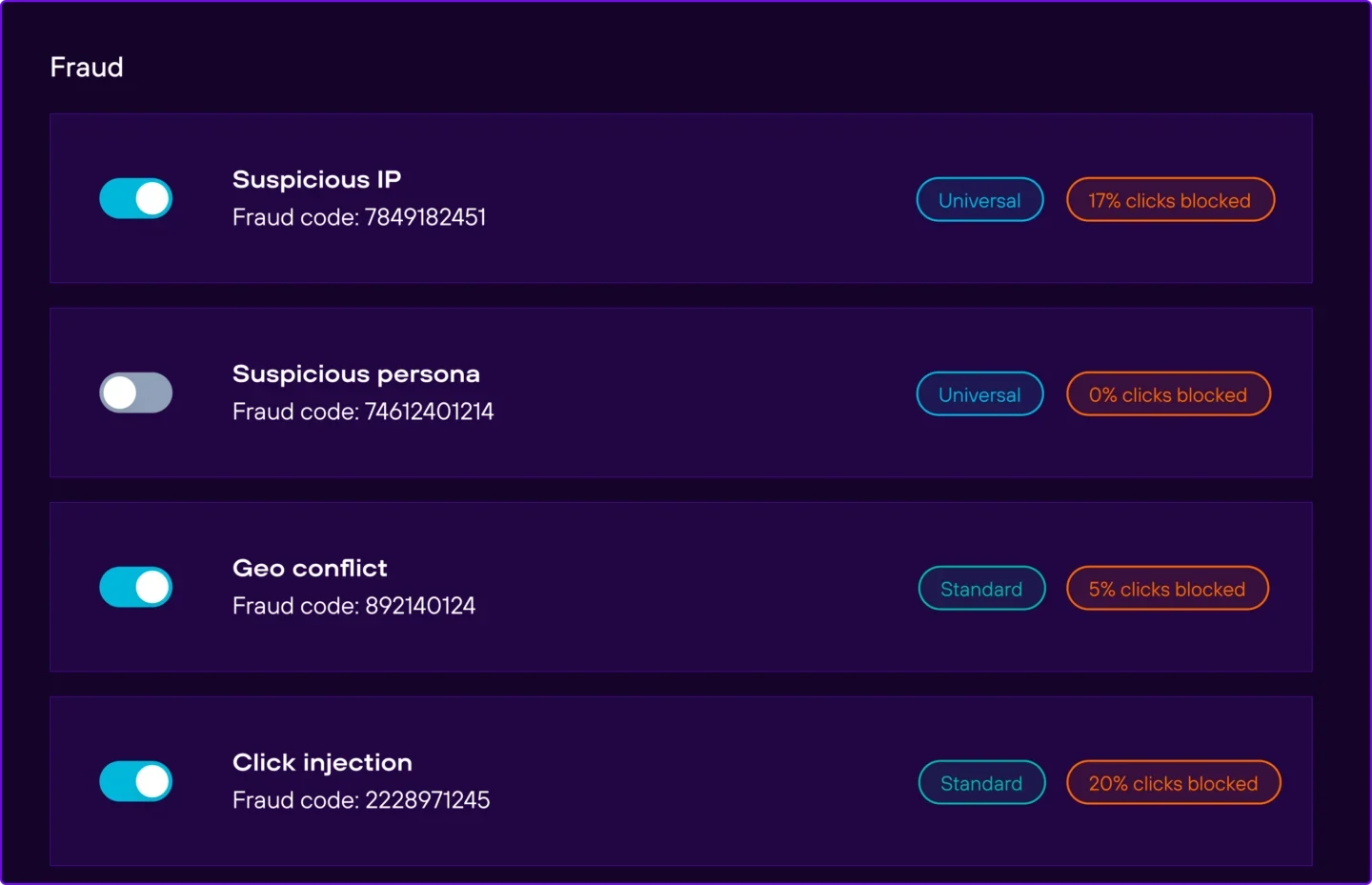
Branch fraud detection uses proprietary algorithms, dynamic rules, and statistical pattern detection across a large pool of data signals to flag and block suspicious installs before they’re ever credited to a paid channel.
Partner management and transparency
Technology won’t fix install fraud if your media partners are the source. Establish baseline performance metrics for every partner, tracked per network:
- Install-to-registration rates
- First-session behavior patterns
- Downstream conversion metrics
When you segment by partner, fraudulent sources surface fast. Before adding new networks, vet them on the criteria below:
- Fraud prevention measures: Request detailed information about what each partner has in place.
- References: Ask for references from other fintech advertisers.
- Test budgets: Start small to validate traffic quality before scaling spend.
- Granular reporting: Demand sub-publisher IDs, device-level data, and timestamp information that allows you to cross-reference installs against your own attribution records.
Networks that won’t provide this level of transparency should raise immediate red flags.
When a sub-publisher’s fraud rate exceeds 15%, open a conversation with the partner about that source. Above 20%, stop running their traffic until they remediate. These thresholds align with Branch’s standard fraud recommendations and give you a defensible line for pausing spend.
Building a comprehensive fake install defense strategy
Fraud prevention is a layered stack, and the attribution layer is the last checkpoint, not the first. Pre-bid filtering inside demand-side platforms (DSPs) and supply-side platforms (SSPs) blocks suspicious inventory before a bid clears. Ad networks score clicks and impressions in flight. Your attribution platform sees every install at the moment credit gets assigned, which is where Branch’s native fraud defense operates, automatically flagging suspicious events and giving you transparency into what was blocked and why.
Establish clear fraud thresholds and automated responses. Define the metrics that trigger investigations: install-to-registration below 15%, abnormal install volumes from specific sub-publishers, or geographic anomalies outside your campaign targeting. Map threats by severity and assign response protocols, with SDK spoofing and device emulation triggering immediate partner suspension and forensic analysis. When vetting partners, prioritize those with adaptive, algorithm-driven detection. Static blocklists cannot keep pace with fraud operations that actively study and engineer around fixed rules.
See how Branch’s built-in fraud detection keeps fake installs out of your attribution data, so every dollar of acquisition spend drives a real customer instead of a bot
Frequently asked questions about fake app installs
Fraudulent install spikes appear disconnected from campaign timing and produce abnormally low downstream conversion rates, while tracking issues affect attribution accuracy without changing user quality metrics.
Examine whether your install surge aligns with active campaigns, new creative, or seasonal trends. Also analyze post-install behavior: legitimate users progress through onboarding at predictable rates, while fake installs show zero engagement beyond the attribution event. Check for geographic anomalies: If installs suddenly concentrate in regions where you’re not running campaigns, or if device distributions shift toward older models or obscure manufacturers, fraud is the likely culprit.
There’s no single threshold that signals fraud on its own because install-to-registration rates vary heavily by fintech sub-vertical and acquisition channels. The fraud signal isn’t the absolute number, it’s the deviation. If one partner’s install-to-registration rate sits well below your own historical baseline for that channel, or one sub-publisher delivers 8% while the rest of your network delivers 30% to 40%, that’s the signal worth investigating.
Always segment by traffic source, compare against your own baselines rather than universal thresholds, and combine the metric with corroborating signals like click-to-install time and post-install event depth before concluding it is fraud.
Not always. It depends on where in the stack you need coverage. Branch handles fraud at the attribution layer, where every install converges and credit decisions get made. What Branch doesn’t do is operate upstream of the install, like pre-bid filtering inside DSPs and SSPs or click scoring inside ad networks. If most of your spend runs through programmatic display, a dedicated pre-bid vendor on top of your MMP is usually worth it. If most runs through MMP-integrated ad networks that score traffic upstream, attribution-layer detection plus the network’s own filtering is usually enough.