

In 2025, AI search went from a rounding error to a meaningful share of enterprise traffic. Now 98% of enterprise marketing leaders are either actively optimizing for it or planning to within 12 months, and 28% are putting more than half their marketing budget behind it. Branch surveyed 300 of those leaders to find out what’s actually working, what isn’t, and where the blind spots are.
AI search is growing fast, but it’s not replacing traditional SEO
The most common assumption about AI search is that it will cannibalize Google. The data says otherwise. Enterprise leaders project traditional search engine optimization (SEO) traffic will grow from a mean of 45% of website traffic in 2025 to 53% in 2026. At the same time, they expect AI search traffic to grow from 35% to 50%.
Both channels are expanding simultaneously. Leaders aren’t choosing between SEO and AI search — they’re managing both, which means more touchpoints to track and more complex attribution to solve.
The growth of AI search is significant: Only 26% of respondents said AI search drove more than half their website traffic in 2025. By the end of 2026, 49% expect to hit that threshold. That’s nearly a 2x increase in one year.
AI search already improved marketing performance for 89% of enterprise leaders
In 2025, AI search moved from promising to proven for most enterprise marketers. Among the 300 leaders surveyed:
- 89% said AI-powered search and large language model (LLM) platforms improved their marketing performance.
- 35% saw significant improvement (10% or more).
- 54% saw slight improvement (under 10%).
- Only 3% saw performance decline.
The impact spread across the entire marketing organization, not just SEO teams. Performance marketing (62%), product marketing (59%), customer relationship management (CRM) and lifecycle marketing (52%), and data and analytics (45%) all reported meaningful impact.
Enterprise marketers are shifting major budgets to AI search in 2026
When a channel delivers results, investment follows. Among enterprise leaders surveyed:
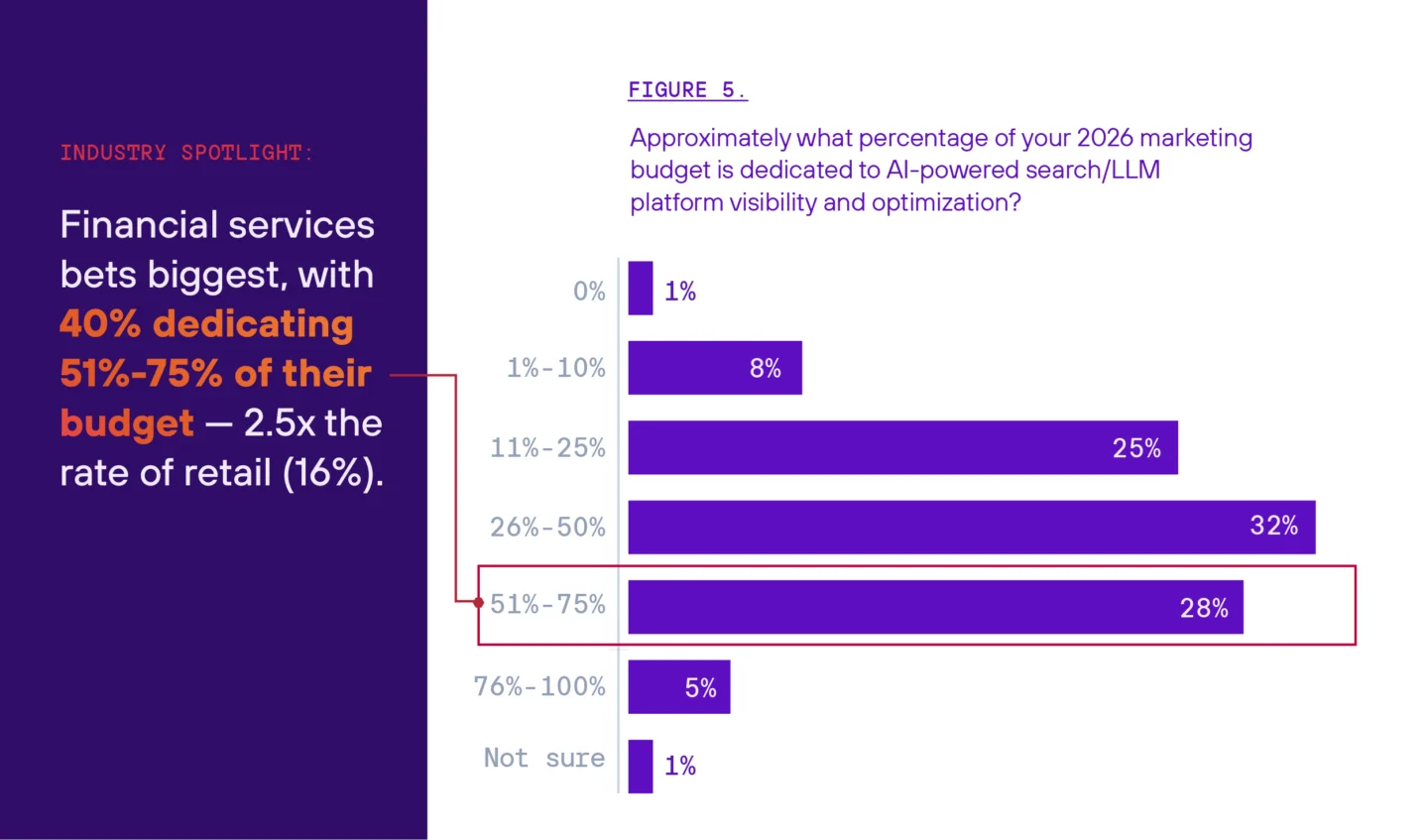
- 65% are dedicating at least 25% of their 2026 marketing budget to AI search optimization.
- 28% are allocating more than half their budget to AI search.
- 98% are either actively optimizing for AI search or planning to within 12 months.
Financial services is making the biggest bet: 40% of financial services respondents are committing a majority of their budget to AI visibility — 2.5x the rate of retail.
The top optimization tactics are foundational, not tactical: improving crawlability for AI-powered search tools (62%), tracking and measuring AI-driven traffic (60%), creating LLM-friendly content formats like FAQ and Q&A (58%), and refreshing existing content for AI summaries (56%).
Eighty-seven percent of enterprise leaders expect AI platforms to close sales in 2026
This is no longer just a discovery story. Among the 300 leaders surveyed, 87% expect platforms like ChatGPT, Perplexity, and Google’s AI Overviews to complete closed-loop transactions for their company’s products within the next 12 months.
Industry expectations for a significant positive impact from agentic AI vary:
- Retail and e-commerce: 64%
- Financial services: 58%
- Health and wellness: 58%
- Food and beverage: 44%
- Media and entertainment: 36%
- Travel and hospitality: 24%
Travel and hospitality is notably skeptical — only 24% expect significant impact, with most viewing AI search as a helpful but not transformational channel.
Sixty-six percent say they’re confident measuring AI conversions, but the data tells a different story
Here’s the finding that should give enterprise leaders pause. Two-thirds of respondents (66%) report feeling “very” or “extremely” confident in their ability to measure AI-driven conversions. Eighty percent say AI attribution is clearer than traditional SEO.
But when asked about their biggest measurement challenges, the same group reported:
- 26% cannot track the user journey from AI discovery to conversion.
- 24% say their analytics tools aren’t capable of handling AI attribution.
- 16% lack referral data from AI platforms.
- 14% have no clear attribution model for AI traffic.
The explanation for this contradiction: AI search volumes are still relatively small, and most teams are measuring simple referral traffic from AI platforms. That’s not the same as understanding how AI influences the full path to purchase. When someone encounters a brand in an AI Overview and converts three days later through direct or branded search, the AI touchpoint disappears from the attribution model entirely.
The biggest concerns: accuracy, transparency, and data privacy
When asked about their biggest concerns or opportunities regarding AI-driven discovery, leaders skewed cautious: 61% cited concerns, while 39% focused on opportunity.
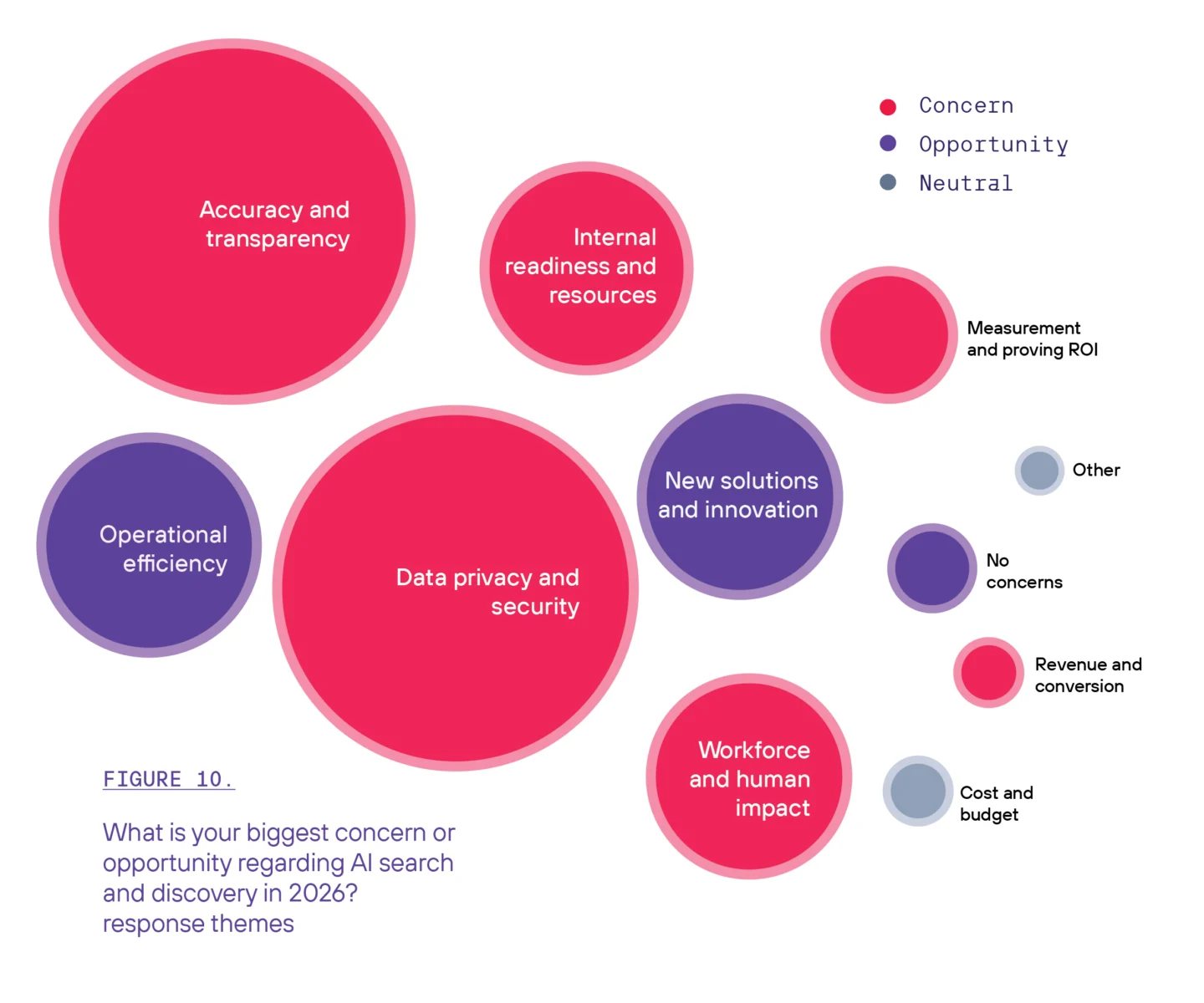
Here are the top concerns among enterprise marketing leaders in 2026:
- Accuracy and transparency: 19% (AI hallucinations, unreliable outputs, inability to verify what AI platforms say about their brand)
- Data privacy and security: 19% (particularly acute in healthcare and financial services)
- Internal readiness and resources: 11%
- Workforce and human impact: 10%
- Measurement and return on investment (ROI): 7%
The fact that measurement and ROI ranked lower than expected — despite 26% citing journey tracking as their biggest practical challenge — suggests leaders may be underestimating how much the measurement gap will matter when stakeholders demand accountability.
About the research
Branch surveyed 300 enterprise marketing, growth, and digital leaders in the United States in January 2026. All respondents work at companies with 500 or more employees. The survey covered six industries: financial services, food and beverage, health and wellness, media and entertainment, retail and e-commerce, and travel and hospitality. Respondents spanned C-suite (22%), director level (66%), and VP or SVP level (12%) roles across data and analytics, e-commerce and digital, growth, marketing, and product functions.
Frequently asked questions (FAQs) about AI search and discovery
No, according to Branch’s 2026 survey of 300 enterprise leaders. Enterprise leaders expect both channels to grow simultaneously. Traditional SEO traffic is projected to grow from a mean of 45% to 53% of website traffic by the end of 2026, while AI search traffic is projected to grow from a mean of 35% to 50% over the same period.
According to Branch’s 2026 AI Search and Discovery Enterprise Benchmark Report, 65% of enterprise marketing leaders are dedicating at least 25% of their 2026 marketing budget to AI search optimization. Twenty-eight percent are allocating more than half their total marketing budget to AI search. Ninety-eight percent are either actively optimizing or planning to within 12 months.
Financial services leads all industries surveyed. Forty percent of financial services respondents are committing a majority of their marketing budget to AI search visibility — 2.5x the rate of retail and e-commerce respondents.
Yes, for the vast majority of enterprise leaders. In Branch’s survey, 89% of respondents said AI-powered search and LLM platforms improved their marketing performance in 2025. Thirty-five percent saw significant improvement of 10% or more, and 54% saw slight improvement. Only 3% reported a performance decline.
Yes. Eighty-seven percent of enterprise leaders surveyed expect platforms like ChatGPT, Perplexity, and Google’s AI Overviews to complete closed-loop transactions for their company’s products within the next 12 months. Ninety-one percent say agentic AI will have a positive impact on their business overall.
Reported confidence is high but may be overstated. Sixty-six percent of respondents say they feel “very” or “extremely” confident measuring AI-driven conversions, and 80% say AI attribution is clearer than traditional SEO. However, 26% of the same group report being unable to track the user journey from AI discovery to conversion, and 24% say their analytics tools aren’t capable of handling AI attribution. Most teams are measuring referred traffic from AI platforms rather than AI’s full influence on the path to purchase.
Accuracy and transparency tied with data privacy and security as the top concerns, each cited by 19% of respondents. Leaders worry about AI hallucinations, unreliable brand representations, and data compliance — particularly in regulated industries like healthcare and financial services. Overall, 61% of respondents skewed toward concerns rather than opportunities when asked about AI-driven discovery.
The top tactics reported in Branch’s 2026 benchmark survey: improving crawlability for AI-powered search tools (62%), tracking and measuring AI-driven traffic and citations (60%), creating LLM-friendly content formats such as FAQ and Q&A pages (58%), and refreshing and restructuring existing content for AI summaries (56%). Most of this work is happening in-house — only 25% are working with outside agencies or vendors.
Generative engine optimization (GEO) is the practice of optimizing content and brand presence to appear in AI-generated responses from platforms like ChatGPT, Perplexity, and Google’s AI Overviews. Unlike traditional SEO, which focuses on ranking in a list of links, GEO is concerned with whether a brand is included in synthesized answers that AI platforms generate on a user’s behalf. According to experts cited in Branch’s benchmark report, GEO strategy at its most advanced involves structured data built for AI consumption, systematic monitoring of how AI models respond to queries about a brand, and closed feedback loops into content and data architecture.